Growing Sectionalism
Growing Sectionalism. Chapter 3, Section 3. An ‘Era of Good Feelings’. This era has been nicknamed the ‘Era of Good Feelings’ because of the surge in nationalism– glorification of one’s country– that occurred following the War of 1812.

Growing Sectionalism
E N D
Presentation Transcript
Growing Sectionalism Chapter 3, Section 3
An ‘Era of Good Feelings’ • This era has been nicknamed the ‘Era of Good Feelings’ because of the surge in nationalism– glorification of one’s country– that occurred following the War of 1812. • The Democratic-Republicans were not challenged politically, as James Monroe easily won re-election.
Domestic Policies • Henry Clay pushed his economic policy (called the American System), which would stabilize the U.S. economy and yield internal improvements. • John Marshall’s Supreme Court’s encouraged nationwide trade with the following court cases: • McCulloch v. Maryland (1819)– Congress has the power to charter a national bank; • Gibbons v. Ogden (1824)– steamboat traffic is ‘commerce’ and interstate commerce is regulated by the federal gov. • Art and literature reflected nationalism American Renaissance. • Hudson River School= landscape paintings
Foreign Policies • John Quincy Adams, Monroe’s Secretary of State, used the sense of nationalism to expand the nation. • In 1819, the Spanish agreed to sell Florida to the United States. The terms of the Adams-Onis Treaty also ended claims to the Pacific Territory of Oregon. • In order to prevent future conflicts with European nations, Adams formulated the Monroe Doctrine, which stated that Europeans would stay out of American affairs.
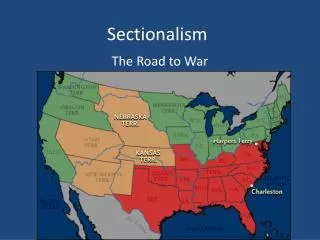
The Missouri Compromise- Background • Growing tensions between the regions (sectionalism) still lingered, mainly over the issue of slavery. • Missouri wanted to be admitted to the U.S. • The balance of an equal # of free and slave states would be upset. • Missouri wanted to enter as a slave state. • Henry Clay (the Great Compromiser) created the Missouri Compromise to appease both the slave-holding South and the North.
Missouri Compromise- Stipulations • Clay proposed that Missouri would be admitted as a slave state, but the northern district of Mass. (i.e. Maine) would enter as a free state. • This would maintain the numbers balance. • To eliminate further debate, a line was drawn at the 36°30’ parallel. • This line exemplified the regional split– slavery in the South, no slavery in the North.
Jacksonian Democracy Chapter 3, Section 4
The Election of 1824 • The election of 1824 pitted four candidates for the presidency. • John Quincy Adams (Monroe’s Sec of State) • Andrew Jackson (war hero from TN) • Henry Clay (Kentucky) • William Crawford (GA) • Jackson won the popular vote, but did not have a majority of the electoral votes. • The decision went to the House of Reps • Henry Clay threw his support to Adams. When Adams won the election, Clay was named his Secretary of State. • Jackson accused the two men of a “corrupt bargain”.
Jackson’s Response • Jackson began working towards the 1828 election. • He did something new to the presidency– he went across the country campaigning for himself. • This coincided with a change in the election process for many states. • Electors would be chosen based on the popular vote; • Many states eliminated the property requirement to vote to accommodate the low wages of industrial workers. • Free blacks and women were still restricted from voting.
Jackson Emerges • Jackson was seen as the embodiment of democratic principles. • He promoted majority rule and the power of the common man. • Jackson’s supporters called themselves Democrats. • Jackson easily won the election with 56% of the popular vote and 2/3 of the electoral vote. • Jackson’s campaign (led by his manager Martin Van Buren) promised a return to Jeffersonian principles. • Jackson also promised not to interfere with the issue of slavery.
The Spoils System • The Democrats transformed party structure. Everyone in the party, no matter their political level, had to obey democratic principles or else be cast out. • Elections became more business-like with ‘professional politicians’ and campaign managers. • Those loyal to the party were rewarded with government jobs. • When Jackson became president, Martin Van Buren became Secretary of State. (Sound familiar?) • The practice of rewarding followers with government jobs became known as the spoils system.
Native Americans • Much of Jackson’s support came from the South. • When Southerners asked that 60,000 Native Americans be removed from land viable for cotton, Jackson obliged. • Jackson had already petitioned Congress to pass the Indian Removal Act. • This would negotiate a land tradeoff– give up southern lands for land in he Indian Territory (Oklahoma)
Native Americans • In Worchester v Georgia (1832), the Native Americans took their case to the Supreme Court. • John Marshall ruled in favor of the Native Americans keeping their land. • Jackson’s response “John Marshall has made his decision. Now let him enforce it.” • Jackson required Native Americans to walk from Georgia to Oklahoma on what would become known as the Trail of Tears.
Review Questions • How did McCulloch v. Maryland (1819) and Gibbons v. Ogden (1824) demonstrate nationalism? • The cases demonstrated a push for states’ rights. • The cases further established powers of the federal government. • The cases promoted the rights of immigrants. • The cases stopped immigration. • What territory did the United States NOT acquire during the Era of Good Feelings? • Florida • Present-day Oregon • Texas • Present-day Washington
Review Questions • Why did Jackson lose the election of 1824? • He did not receive a majority of the popular vote • Clay dropped from the race and pledged his support to Adams if he was named Secretary of State • He did not have any notoriety • Jackson did not run in 1824. • Why were Native Americans forced off of their land? • White settlers wanted the resources • They had signed a treaty to give up the land, but then changed their mind. • The land was not habitable any longer • They preferred to live in Oklahoma
Ticket-Out-the-Door • What was the experience like of the Native Americans who were on the Trail of Tears?