Queueing Lessons
In operations management, the effectiveness of queue structures significantly impacts customer experience. This analysis delves into whether a single line or multiple lines are more efficient. Industries such as airports, grocery stores, and fast-food chains are examined. Findings indicate that a single line generally performs better, preventing bottlenecks caused by slow customers. Additionally, innovative task separation strategies can drastically improve service time, leading to higher customer turnover and satisfaction rates. Simulation tools are recommended for complex scenarios.

Queueing Lessons
E N D
Presentation Transcript
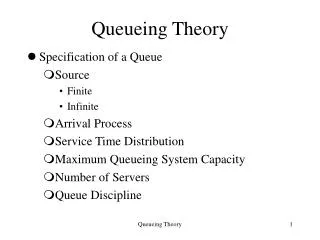
Queueing Lessons Dr. Ron Lembke Operations Management
Which is better, one line or two? • One line: • Airport check-in, security, Best Buy (holidays), Michaels, Taco Bell, most banks • Multiple lines: • Grocery stores, Wal-Mart • In the past: banks, McDonalds, etc. • You don’t get stuck behind a slow person
One line or four? • This cashier is fast/slow! Should I switch? • Sometimes workload is visible: • Grocery store – food in cart • Airport - # of suitcases? • Bank – no clue at all • Starbucks – one person – drinks for office 1 2 3 4
Multiple Servers, One Line 1 2 3 4
Multiple Servers, One Line 1 2 3 4
Separating Multiple Tasks • Then: CT = 6 min/customer = 10/hr • Place order and pay (2 min) • Cashier gets food from heat lamps (3 min) • Cashier gets your drink (1 min) • Now: CT = 2 min/customer = 30/hr • Place order and pay (2 min), get own drink • Customers/labor hour = 200% increase! • Plus, free refills! (and suicides, if you’re a middle schooler) • Guaranteed right drink: regular/diet, how much ice
Cashier Gets Food and Drink? time Order/pay Food prep Get Drink If you just pay the cashier and get your own drink while someone else gets the food, it’s a lot faster
System Structure • The more comlicated the system, the harder it is to model: • Separate lines • Separate tellers, etc.
Factors to Consider • Arrival patterns, arrival rate • Size of arrival units – 1,2,4 at a time? • Degree of patience • Length line grows to • Number of lines – 1 is best • Does anyone get priority?
Service Time Distribution • Deterministic – each person always takes 5 minutes • Random – low variability, most people take similar amounts of time • Random – high variability, large difference between slow & fast people
Now what? • Simulate! • Build a computer version of it, and try it out • Tweak any parameters you want • Change it as much as you want • Try it out with zero risk
What did we learn? • Queueing Theory can help with simple capacity decisions • One line is better than two • Splitting tasks can get people through faster • Reality is filled with queueing systems that are far more complex than that • Simulation needed for more complex ones