Understanding Simulation and Statistics in Queue Management Systems
This document discusses various statistical metrics relevant to simulation and queue management, including average wait time, server utilization, and traffic intensity. Key calculated results such as average service time and probability of customer wait provide insights into system performance. Definitions of random variables, discrete vs. continuous distributions, and cumulative distribution functions (CDFs) are included to establish a statistical framework. Practical examples illustrate how these concepts apply in real-world scenarios, enhancing understanding of handling queues effectively.

Understanding Simulation and Statistics in Queue Management Systems
E N D
Presentation Transcript
Simulation Statistics • Numerous standard statistics of interest • Some results calculated from parameters • Used to verify the simulation • Most calculated by program
Some Statistics Average Wait time for a customer = total time customers wait in queue total number of customers Average wait time of those who wait = total time of customers who wait in queue number of customers who wait
More Statistics Proportion of server busy time = number of time units server busy total time units of simulation Average service Time = total service time number of customers serviced
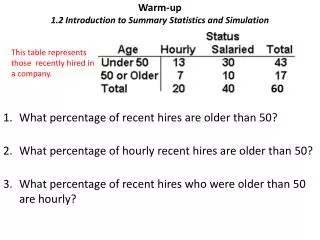
More Statistics Average time customer spends in system = total time customers spend in system total number of customers Probability a customer has to wait in queue = number of customers who wait total number of customers
Traffic Intensity • A measure of the ability of the server to keep up with the number of the arrivals • TI= (service mean)/(inter-arrival mean) • If TI > 1 then system is unstable & queue grows without bound
Server Utilization • % of time the server is busy serving customers • If there is 1 server • SU = TI = (service mean)/(inter-arrival mean) • If there are N servers • SU = 1/N * (service mean)/(inter-arrival mean)
Statistical Models • Probability: a quantitive measure of the chance or likelihood of an event occurring. • Random: unable to be predicted exactly • In an experiment where events randomly occur but in which we have assigned to each possible outcome a probability, we have determined a probability or stochastic model
Terms • Event Space • Event • Complement of an Event • Intersection • Union • Mutually Exclusive
Examples • Event Space: The set of all possible events that can occur • ex: {1,2,3,4,5,6} • Event (E): Any single occurrence • ex: E = {4,5} • Complement of E: • Set of all events except E • Ex: Complement of E = {1,2,3,6}
Examples • Union: Combination of any 2 event sets • A= {1,2,3} • B = {3,4} • A U B = {1,2,3,4}
Examples • Intersection: Overlap of common occurrence of 2 event sets • A= {1,2,3} B = {3,4} • A Π B = {3} • Mutually Exclusive: 2 event sets that have no events in common • A= {1,2} B = {3,4} • A Π B = { }
Random variable Practical Definition • a quantity whose value is determined by the outcome of a random experiment
Random Variable Examples • X = the number of 4's that occur in 10 rolls • Y = the number of customers that arrive in 1 hour • Z = the number of services that are completed in 5 minutes
Discrete vs. Continuous RV EXAMPLE • Discrete: X = number of customers that arrive in 1 hour • Continuous: Y = gallons that flow into the pool in 1 hour • ????: Z = the average age of the customers that arrive in an hour
Discrete: Probability Function Let X be a discrete R.V. with possible values x1, x2,…xn. Let P be the probability function P(xi) = (X = xi) such that (a) P(xi) >= 0 for i = 1,2,…n (b) Σ P(xi) = 1
Probability FunctionExample • Consider the rolling of a fair die 1/6 for x = 1 P(x) = 1/6 for x = 2 1/6 for x = 3 1/6 for x = 4 1/6 for x = 5 1/6 for x = 6 0 for all other x
Cumulative Distribution Function • CDF of a random variable X is F such that F(x) = P (X <= x) • F(X) is continuous • Discrete: sum of probabilities • Continuous: area under the curve
Cumulative Distribution Function - Example • Consider the rolling of a fair die 0 for x < 1 1/6 for x < 2 F(X) = 2/6 for x <3 3/6 for x < 4 4/6 for x < 5 5/6 for x < 6 1 for x >= 6
Cumulative Function 1 1/2 1/6 • 2 3 4 5 6
Discrete vs. Continuous R.V. • Cumulative Distribution Function (CDF) • The CDF of a discrete R.V. X is F such that F(x)= P (X<= x) • Continuous: The CDF of a continuous RV has the properties: • F(x) is continuous, at least piecewise • F(x) exists except in at most a finite number of points
Discrete vs. Continuous Random Variables • Random variable: a function whose domain is the event space & whose range is some subset of real numbers • If a random variable assumes a discrete (finite or countably infinite) number of values, it is called a discrete random variable. Otherwise, it is called a continuous random variable.