Download
1 / 30
300 likes | 410 Views
Buffer overflow is a prevalent attack mechanism first exploited by the Morris Worm in 1988. This vulnerability occurs when more data is input than a buffer can handle, resulting in the overwriting of adjacent memory. This can lead to data corruption, unexpected control transfers, and unauthorized code execution. Despite known prevention techniques, buffer overflows remain a serious concern due to legacy code and careless programming practices. This lecture covers the basics of buffer overflows, their historical context, examples of attacks, and defenses against them.

E N D
Lecture 16Buffer Overflow modified from slides of Lawrie Brown
Buffer Overflow • a very common attack mechanism • first wide use by the Morris Worm in 1988 • prevention techniques known • still of major concern • legacy of buggy code in widely deployed operating systems and applications • continued careless programming practices by programmers
Buffer Overflow/Buffer Overrun • A buffer overflow, also known as a buffer overrun, is defined in the NIST: “A condition at an interface under which more input can be placed into a buffer or data holding area than the capacity allocated, overwriting other information. Attackers exploit such a condition to crash a system or to insert specially crafted code that allows them to gain control of the system.”
Buffer Overflow Basics • programming error when a process attempts to store data beyond the limits of a fixed-sized buffer • overwrites adjacent memory locations • locations could hold other program variables, parameters, or program control flow data • buffer could be located on the stack, in the heap, or in the data section of the process • consequences: • corruption of program data • unexpected transfer of control • memory access violations • execution of code chosen by attacker
Buffer Overflow Attacks • to exploit a buffer overflow an attacker needs: • to identify a buffer overflow vulnerability in some program that can be triggered using externally sourced data under the attacker’s control • to understand how that buffer is stored in memory and determine potential for corruption • identifying vulnerable programs can be done by: • inspection of program source • tracing the execution of programs as they process oversized input • using tools such as fuzzing to automatically identify potentially vulnerable programs
Programming Language History • at the machine level data manipulated by machine instructions executed by the computer processor are stored in either the processor’s registers or in memory • assembly language programmer is responsible for the correct interpretation of any saved data value • modern high-level languages have a strong notion of type and valid operations • C and related languages have high-level control structures, but allow direct access to memory • not vulnerable to buffer overflows • does incur overhead, some limits on use • hence are vulnerable to buffer overflow • have a large legacy of widely used, unsafe, and hence vulnerable code
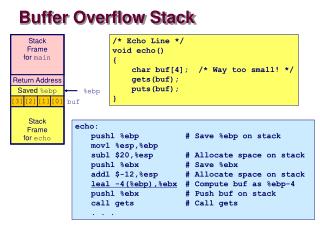
Stack Buffer Overflows • occur when buffer is located on stack • also referred to as stack smashing • exploits included an unchecked buffer overflow • are still being widely exploited • stack frame • when one function calls another it needs somewhere to save the return address • also needs locations to save the parameters to be passed in to the called function and to possibly save register values
Shellcode • code supplied by attacker • often saved in buffer being overflowed • traditionally transferred control to a user command-line interpreter (shell) • machine code • specific to processor and operating system • traditionally needed good assembly language skills to create • more recently a number of sites and tools have been developed that automate this process • Metasploit Project • provides useful information to people who perform penetration, IDS signature development, and exploit research
Stack Overflow Variants • target program can be: • a trusted system utility • network service daemon • commonly used library code • shellcode functions • launch a remote shell when connected to • create a reverse shell that connects back to the hacker • use local exploits that establish a shell • flush firewall rules that currently block other attacks • break out of a chroote (restricted execution) environment, giving full access to the system
Buffer Overflow Defenses • buffer overflows are widely exploited • two broad defense approaches • compile-time • aim to harden programs to resist attacks in new programs • run-time • aim to detect and abort attacks in existing programs
Compile-Time Defenses: Programming Language • use a modern high-level language • not vulnerable to buffer overflow attacks • compiler enforces range checks and permissible operations on variables • disadvantages • additional code must be executed at run time to impose checks • flexibility and safety comes at a cost in resource use • distance from the underlying machine language and architecture means that access to some instructions and hardware resources is lost • limits their usefulness in writing code, • such as device drivers, that must interact with such resources
Compile-Time Defenses: Safe Coding Techniques • C designers placed much more emphasis on space efficiency and performance considerations than on type safety • assumed programmers would exercise due care in writing code • programmers need to inspect the code and rewrite any unsafe coding • an example of this is the OpenBSD project • programmers have audited the existing code base, including the operating system, standard libraries, and common utilities • this has resulted in what is widely regarded as one of the safest operating systems in widespread use
Compile-Time Defenses: Language Extensions / Safe Libraries • handling dynamically allocated memory is more problematic because the size information is not available at compile time • requires an extension and the use of library routines • programs and libraries need to be recompiled • likely to have problems with third-party applications • concern with C is use of unsafe standard library routines • one approach has been to replace these with safer variants • Libsafe: library is implemented as a dynamic library arranged to load before the existing standard libraries
Compile-Time Defenses: Stack Protection • add function entry and exit code to check stack for signs of corruption • use random canary • value needs to be unpredictable • should be different on different systems • Stackshield and Return Address Defender (RAD) • GCC extensions that include additional function entry and exit code • function entry writes a copy of the return address to a safe region of memory • function exit code checks the return address in the stack frame against the saved copy • if change is found, aborts the program
Run-Time Defenses: Executable Address Space Protection • use virtual memory support to make some regions of memory non-executable • requires support from memory management unit • long existed on SPARC / Solaris systems • recent on x86 Linux/Unix/Windows systems • issues • support for executable stack code • e.g., Java Runtime system • special provisions are needed
Run-Time Defenses: Address Space Randomization • manipulate location of key data structures • stack, heap, global data • using random shift for each process • large address range on modern systems means wasting some has negligible impact • randomize location of heap buffers • random location of standard library functions
Run-Time Defenses: Guard Pages • place guard pages between critical regions of memory • flagged in memory management unit as illegal addresses • any attempted access aborts process • further extension places guard pages between stack frames and heap buffers • cost in execution time to support the large number of page mappings necessary
Summary • buffer overflow (buffer overrun) • more input placed into a buffer than the allocated capacity • stack buffer overflows • targeted buffer is located on the stack • function call mechanisms • stack frame • stack overflow vulnerabilities • shellcode • shellcode development • position independent • cannot contain NULL values • compile-time defenses • resist attacks in new programs • run-time defenses • detect and abort attacks in existing programs • stack protection mechanisms