Download
1 / 10
100 likes | 191 Views
Explore key outcomes from the ECE Regional Preparatory Meeting for the UN Conference on Sustainable Development in 2011, covering progress assessment, challenges, green economy strategies, and institutional framework enhancements.

E N D
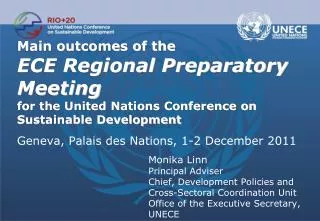
Main outcomes of theECE Regional Preparatory Meetingfor the United Nations Conference on Sustainable DevelopmentGeneva, Palais des Nations, 1-2 December 2011 • Monika Linn • Principal Adviser • Chief, Development Policies and • Cross-Sectoral Coordination Unit • Office of the Executive Secretary, UNECE
Participation • More than 400 participants from: • Member states • UN system • Intergovernmental organizations • Major groups
Inputs • Seventh « Environment for Europe »Ministerial Conference (Astana, Sept. 2011) • Meetings of Parties of Aarhus and Espoo Conventions • Regional Inter-agency Report « From Transition to Transformation. Sustainable and Inclusive Development in Europe and Central Asia »
Format and Outcome of the meeting A 2-day meeting divided into 3 thematic segments: • Assessment of progress in the implementation of the outcomes of the major summits on SD and addressing new and emerging challenges • A green economy in the context of sustainable development and poverty eradication • The institutional framework for sustainable development (IFSD) A Co-Chairs’ Summary (E/ECE/RPM/2011/2/Add.1)
Main outcomes:Theme 1. Assessment of progress (1) Progress in the UNECE region on SD since 1992 in the following areas: • Implementation of MEAs at global and regional levels • Five ECE MEAs supporting SD in the region • Importance of the “Environment for Europe” process, including successful Astana Ministerial Conference • Cross-cuttingissues: ESD, R&D, transfer of knowledge and technology
Main outcomes:Theme 1. Challenges (2) Improvement required in the following areas: • Addressing equity issues • Gender inequality • Monitoring of progress in achieving SD • Promoting cross-sectoral approaches • Economic instruments • Implementing Rio Principles • Energy efficiency and security, and access to sustainable energy for the poor • Inclusion of disaster risk reduction in development strategies
Main outcomes:Theme 2. Green economy (1) • No one-size-fits-all solution • An internationally agreed Green Economy roadmap, with political and action-oriented components and a policy toolbox • Sustainable production and consumption patterns • Green economy, poverty and employment • Identifying priorities and designing policy mixes for the green economy • Promoting innovation and new technologies for sustainable development • Financial support • Engaging the private sector
Main outcomes:Theme 2. Green economy (2) • Public procurement • The role of multilateral environmental agreements • Sustainable energy • Water and sanitation • Food security and sustainable agriculture • Indicators measuring progress towards a green economy
Main outcomes:Theme 3. IFSD • Consensus on the need for improvement • Reform of IFSD required at all levels • Global • upgrade UNEP • SD Council • Regional • strengthen RCs • intra- and subregional cooperation • regional MEAs • National • ‘whole of government’ approach • national SD Councils • engagement of civil society
Thank you! Palais des Nations 1211 Geneva 10 Switzerland http://www.unece.org/env/sustainabledevelopment/rpm2011/rpm2011.html