Exploring Protists: Characteristics, Life Cycles, and Reproductive Methods
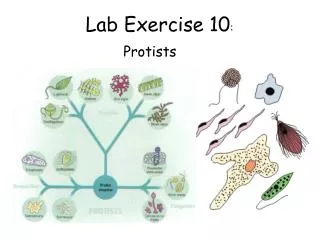
This lab exercise focuses on various protists, including Entamoeba histolytica, Giardia lamblia, and more. Students will learn how Entamoeba histolytica differs from Amoeba proteus, explore the life cycles of Plasmodium, and understand reproductive methods in different protist species like Paramecium and Spirogyra. Additionally, the exercise covers the habitats and structures of diatoms and algae, examining their ecological roles. Through practical wet mounts, participants will observe flagellates, ciliates, and slime molds to enhance their understanding of these diverse microorganisms.

Exploring Protists: Characteristics, Life Cycles, and Reproductive Methods
E N D
Presentation Transcript
Lab Exercise 10: Protists
Station 1. Entamoeba histolytica Cysts are ingested in contaminated water or food and then trophozoites hatch out in the intestines and can be seen in fecal smears Name two ways parasitic Entamoeba histolytica is different from its pond water ‘cousin’ Amoeba proteus Answer: It has no contractile vacuoles or food vacuoles
Station 3: Giardia lamblia flagella
Vaginal smear Station 4: Trichomonas vaginalis
b. Method of reproduction? Asexual or sexual? Conditions? Station 5. Paramecium caudatum a. Method of reproduction? Asexual or sexual? Conditions? c. Anterior or posterior end? Answers: a. binary fission, asexual, good conditions b. conjugation, sexual, harsh conditions c. anterior end
Station 6. Plasmodium life cycle Sporogony zygotes Fertilization occurs Gametocytes Macro and micro Schizogony form Schizogony (10-14 days) 48 hour cycles
Station 7. Physarum (slime mold) cyclosis
Station 9. Dinoflagellates Name of groove? Answer: annulus
Station 10. Diatoms Habitats? Cell wall composed of? Answer: silica (glass) Answer: round marine, elongated freshwater
Station 12. Filamentous Green algae b. Haploid (n) or diploid (2n)? Spirogyra a. Type of reproduction? Asexual or sexual? Conditions? Answers: a. conjugation, sexual, harsh conditions b. diploid (2n)
Station 14. Brown agae blade Kelp algin