The Plasma Membrane -
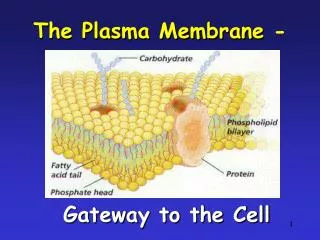
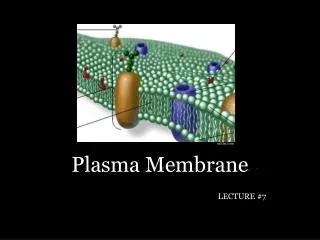
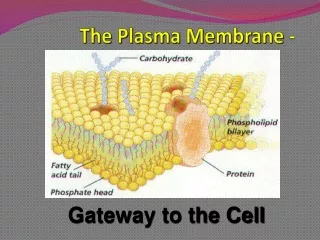
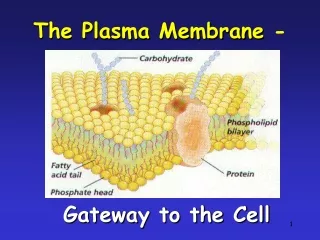
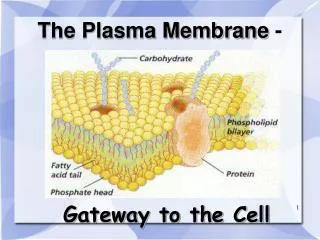
The Plasma Membrane -. Gateway to the Cell. Photograph of a Cell Membrane. The cell membrane is flexible and allows a unicellular organism to move. Cell Membrane. Balanced internal condition of cells Also called equilibrium

The Plasma Membrane -
E N D
Presentation Transcript
The Plasma Membrane - Gateway to the Cell
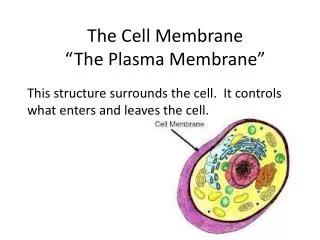
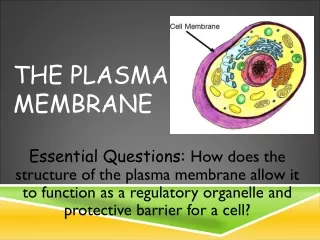
The cell membrane is flexible and allows a unicellular organism to move Cell Membrane
Balanced internal condition of cells • Also called equilibrium • Maintained by plasma membrane controlling what enters & leaves the cell Homeostasis
Functions of Plasma Membrane 1. Protective barrier 2. Regulate transport in & out of cell (selectively permeable) 3. Allow cell recognition 4. Provide anchoring sites for filaments of cytoskeleton
Functions of Plasma Membrane 5. Provide a binding site for enzymes 6. Interlocking surfaces bind cells together (junctions) 7. Contains the cytoplasm (fluid in cell)
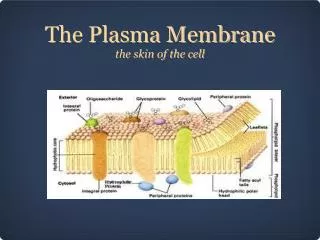
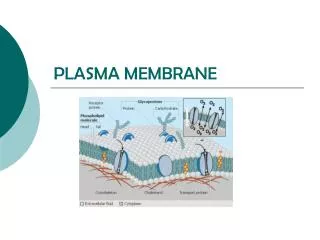
Make up the cell membrane Phospholipids Contains 2 fatty acid chains that are nonpolar Head is polar & contains a –PO4 group
Cell Membrane Polar heads are hydrophilic “water loving” Nonpolar tails are hydrophobic “water fearing” Makes membrane “Selective” in what crosses
Materials that are soluble in lipids can pass through the cell membrane easily Solubility
Molecules cross the membrane in several ways. Some methods require the cell to expend energy, some do not. How a particular molecule crosses the membrane depends on the molecules size, polarity, and concentration inside versus outside the cell. Small non-polar molecules easily pass through the membrane. Small polar molecules are transported via proteins. Large molecules are moved in vesicles. Crossing the membrane.
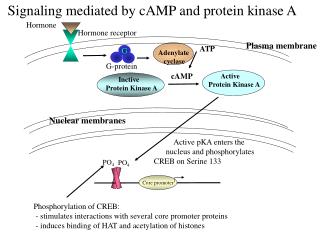
A receptor is a protein that detects a signal molecule and performs an action in response. It recognizes and binds to only certain molecules, which ensures that the right cell gets the right signal at the right time. When receptors are activated (they combine with a hormone or neurotransmitter), they change shape. This relays information to the cell. Chemical signals are transmitted across the cell membrane