
Simple Machines
E N D
Presentation Transcript
Simple Machines SPH4C March 2010
History • Archimedes – 3rd Century BC • Heron of Alexandria – 10-75 AD • Galileo Galilei – 1600 AD
What is a machine? • Device that allows us to do work with less effort. • Work is done when a force moves an object in the direction of that force.
Work • Work is the energy transferred to an object. • Machines make work easier. • W is the work done on the object, • F is the magnitude of the force, • Δd is the magnitude of the displacement.
Machines • Machines are designed to achieve at least one of five main functions: • Change energy from one form into another • Transfer forces • Change the direction of a force • Change the magnitude of a force • Change distance or speed
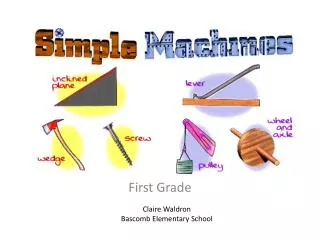
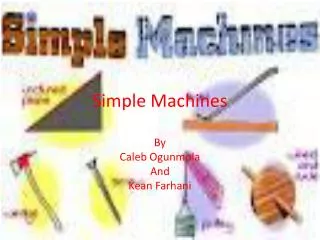
Simple Machine Families • Lever Family • Lever • Pulley • Wheel and axle • Gears • Inclined Plane Family • Inclined plane • Wedge • Screw
Lever A lever is a rigid bar that can rotate freely around a fulcrum ( a support around which a lever can rotate). An effort force, FE, is a force applied to one part of a lever to move a load at another part; the load exerts a load force, FL.
Lever Classes • First-class • Fulcrum between FE and FL • Second-class • FLbetween FEand fulcrum • Third-class • FE between FLand fulcrum
Inclined Planes • An inclined plane is a ramp that increases the load than can be moved by an effort force.
Inclined Planes • A wedge is a double inclined plane that increases the applied or effort force. • A screw is an inclined plane wrapped around a central shaft that increases the applied or effort force.
Compound Machines • A machine made of two or more simple machines.