Download
1 / 25
260 likes | 385 Views
The electromagnetic spectrum encompasses a range of waves formed by changes in electric and magnetic fields. These transverse waves do not require a medium and can travel through empty space at the speed of light. The spectrum includes various types of EM waves: radio waves, microwaves, infrared, visible light, ultraviolet, X-rays, and gamma rays. Each type has distinct properties, wavelengths, and frequencies, playing vital roles in communication, heating, vision, and medical applications, such as sterilization and cancer treatment.

E N D
EM Waves • Electromagnetic waves are created by changes in electric and magnetic fields. • These changes in the electric field cause changes in the magnetic field and this change causes another change in the electric field. • The cycle continues. ….
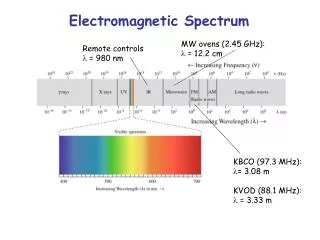
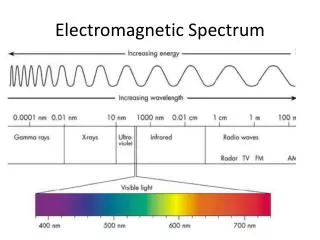
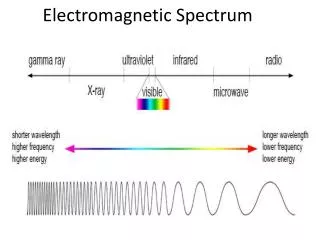
Electromagnetic Waves • There are many type of EM waves. • Sometimes they are referred to as rays. • Electromagnetic Spectrum – name for the range of electromagnetic waves when placed in order of increasing frequency
EM Wave Properties • All EM waves are TRANSVERSE waves • They require NO medium! • They CAN travel through empty space!
EM Waves EM Waves are radiated by ALL objects. They ALL travel at the speed of light. c = 300,000,000 m/s
c = 300,000,000 m/s At this speed the waves could go around the world 8 times in one second!!! How fast is that?!?!
Radio Waves • Have the longest wavelengths and the lowest frequencies. • A radio picks up radio waves sent out from towers and converts them into to sound waves.
AM, FM and TV • AM has the lowest frequency • 535kHz-1605kHz • FM radio and TV have the highest frequency. • 88MHz-108MHz
They also carry signals for your TV and cell phones. But radio waves are also emitted by other things such as stars and gases in space. Radio Waves…
Microwaves • Microwaves are good for transmitting information from one place to another. • Microwaves in space are used to learn about the structure of nearby galaxies.
Microwave ovens: Waves transfer energy to the water in the food causing them to vibrate which in turn transfers energy in the form of heat to the food. • Microwaves can be used for remote controls and radar, too, such as the Doppler radar used in weather forecasts.
Infrared • Infrared waves lie between the visible and microwave part on the EM spectrum. • Far infrared waves are thermal. • Warm objects give off more heat energy than cool objects
Our skin emits infrared waves. • which is why we can be seen in the dark by someone using night vision goggles. • In space, Infrared light maps the dust between stars.
Visible Light • Visible light waves are the only electromagnetic waves we can see. • Each color has a different wavelength. • Red has the longest wavelength and violet has the shortest wavelength. • When all the waves are seen together, they make white light.
Remembering the Colors ROYGBIV
Cones in our eyes are receivers for these tiny visible light waves. • The Sun is a natural source for visible light waves and our eyes see the reflection of this sunlight off the objects around us. • The color of an object that we see is the color of light reflected. • All other colors are absorbed.
Ultraviolet • Ultraviolet (UV) light has shorter wavelengths and a higher frequency than visible light. • We know that the sun is a source of UV rays.
UV Rays • Are why you use sunblock!! • They can do damage to your skin and even cause skin cancer!!! • They come in 2 types A and B
UV RAYS—Uses • Used to kill bacteria and for the sterilization of equipment. • Causes your skin to produce vitamin D (good for teeth and bones) but too much can cause skin cancer.
X-Rays • Shorter wavelength and higher frequency than UV-rays. • Can travel through most matter. • The Earth's atmosphere is thick enough that virtually no X-rays are able to get through from outer space.
Hot gases in the Universe also emit X-rays . • Bones and teeth absorb x-rays. • Used by engineers to check for tiny cracks in structures • Used in airports to check baggage.
Gamma-rays • Gamma-rays have the smallest wavelengths and the highest frequency. • Have the greatest amount of energy and pass through the most. • These waves are generated by radioactive atoms and in nuclear explosions.
Radioactive materials can emit gamma-rays. • They are also produced by supernova explosions or the destruction of atoms, and the decay of radioactive materials. • Gamma-rays can kill living cells, such as cancer cells.