Partial Quotients
50 likes | 151 Views
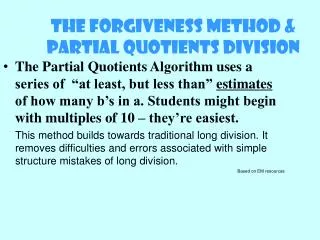
The Partial Quotients Algorithm is an effective method for division that utilizes a series of "at least, but less than" estimates to determine how many times a divisor fits into a dividend. This approach begins with easily manageable multiples, helping students visualize the relationship between multiplication and division. By making sequential estimates and subtracting the products from the dividend, students can find the quotient and remainder. This algorithm not only fosters estimation skills but reduces errors, making it a practical strategy in math learning.


Partial Quotients
E N D
Presentation Transcript
Partial Quotients A Division Algorithm
12 158 The Partial Quotients Algorithm uses a series of “at least, but less than” estimates of how many b’s are in a. Students often begin with multiples of 10 because they’re easiest. 13 R2 There are at least ten 12’s in 158 (10 x 12=120). Record 10 as the first estimate. - 120 10 (10 x 12=120) Subtract 38 There are at least three more (3 x 12 = 36). Record 3 as the next estimate. 3 (3 x 12=36) - 36 Subtract 2 13 (groups of 12) Since 2 is less than 12, you can stop estimating. The final result is the sum of the guesses (10 + 3 = 13) plus what is left over (remainder of 2 )
36 7,891 Let’s try another one 219 R7 - 3,600 100 (100 x 36=3600) Subtract 4,291 - 3,600 100 (100 x 36=3600) Subtract 691 - 360 10 (10 x 36=360) 331 9 (9 x 36=324) - 324 7 219 R7
43 8,572 Now do this one on your own. 199 R 15 How did you do? - 4,300 100 (100 x 43=4300) Subtract 4272 -3870 90 (90 x 43=3870) Subtract 402 Note: You may have chosen different estimates than these. That’s okay. Just remember to use nice numbers to work with and be sure your answer is correct. - 301 7 (7 x 43=301) 101 - 86 2 (2 x 43=86) 15 199 R 15
Partial Quotients This method of dividing supports : • Estimation – students can use any estimate as long as they don’t go over • Multiplication of 10 and 100 • Relationship between multiplication and division And - students make fewer errors.