Download

1 / 3
40 likes | 147 Views
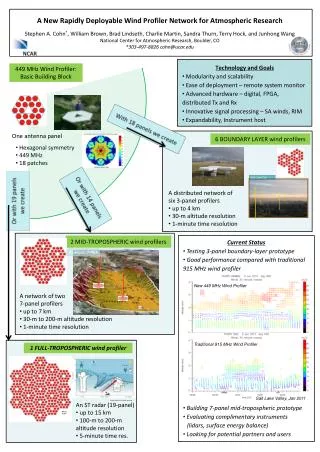
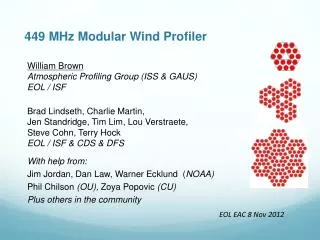
The Modular Profiling Network is set to revolutionize atmospheric research with a rapidly deployable and flexible wind profiling tool. Comprising basic modules with hexagon antenna panels and a 1kW transmitter operating at 449 MHz, this system includes multiple configurations—6 boundary layer profilers for distributed networks, 2 mid-troposphere profilers for comparative studies, and a full-troposphere profiler extending to the UTLS region. With promising test results compared to traditional systems, this innovative network seeks partnerships and collaboration for advanced atmospheric studies.

E N D
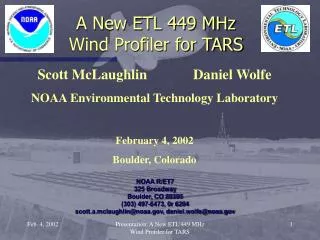
IUGG/IAMAS/JM03 #4431 A New Rapidly Deployable Wind Profiler Network for Atmospheric Research Steve Cohn*, Bill Brown, Brad Lindseth, Charlie Martin, Sandra Thurn, Terry Hock, and June Wang National Center for Atmospheric Research, Earth Observing Lab Boulder, CO, USA The Modular Profiling Network will provide a flexible and reconfigurable profiling tool for the research community.
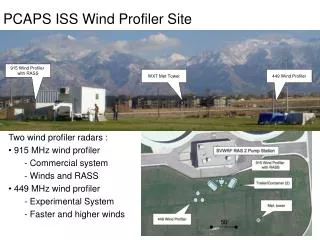
Wind Profiler Modules • Basic Module: • Hexagon antenna panel • Receiver and 1kW transmitter, 449 MHz • With 19 antenna modules we have at least 3 options: • 6 Boundary Layer profilers: • distributed network over wide area • 2 Mid-troposphere profilers: • compare lower troposphere at two sites • 1 Full-troposphere profiler: • profile up to UTLS region
Status 449 MHz • 3-panel prototype tests • Works well compared to traditional 915 MHz boundary layer system • Building 7-panel system 915 MHz • Eventually plan 19+ modules • Complimentary instruments (eg, surface flux & lidar) • Looking for partners and users