Understanding Viral Infection Cycles and Other Infectious Agents
This educational piece explores the mechanisms of viral infections, distinguishing between the lytic and lysogenic cycles. It highlights the harmful impact of specific viruses that kill host cells and outlines the unique characteristics of viroids and prions, which exclusively infect plants and animals respectively. The document also discusses treatment approaches for bacterial infections using antibiotics and addresses the challenges posed by virulent agents like viruses, viroids, and prions, which cannot be effectively treated.

Understanding Viral Infection Cycles and Other Infectious Agents
E N D
Presentation Transcript
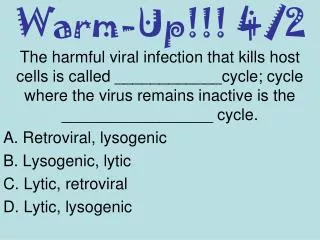
Warm-Up!!! 4/2 The harmful viral infection that kills host cells is called ____________cycle; cycle where the virus remains inactive is the _________________ cycle. A. Retroviral, lysogenic B. Lysogenic, lytic C. Lytic, retroviral D. Lytic, lysogenic
Warm-Up!!! 4/2 The harmful viral infection that kills host cells is the ___________ cycle; cycle where the virus remains inactive is the _________ cycle. A. Retroviral, lysogenic B. Lysogenic, lytic C. Lytic, retroviral D. Lytic, lysogenic
Viroids ~ Viroids are a strand of RNA with NO surrounding protein capsid. ~ Infect ONLY Plants.
Prions ~Particles of Protein that clump together in the brain. ~Infect ONLY animals. ~Cause of ‘Mad Cow’ disease.
Curing Infectious Diseases Bacteria – Killed by antibiotics (which disrupt the bacteria’s cell wall) Viruses– Cannot be killed but can be kept in check with antivirials Viroids & Prions – Cannot be killed or treated