Comprehensive PIC 18F4520 Interfacing Workshop Overview with Professor Consultation Hours
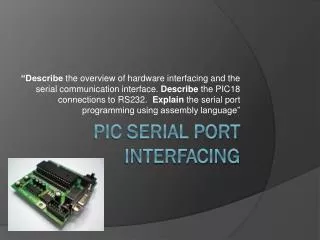
Join us for an in-depth workshop on interfacing with the PIC 18F4520 microcontroller, covering essential digital and analog applications. The workshop includes practical examples such as managing inputs and outputs, utilizing PWM for motor control, and implementing serial communication through RS-232 and I2C. Consultation hours are provided by Professors Michael Peshkin and Kevin Lynch in designated labs, where attendees can seek guidance on project specifics and programming challenges. Expand your knowledge on sensor integration and develop various control systems effectively.

Comprehensive PIC 18F4520 Interfacing Workshop Overview with Professor Consultation Hours
E N D
Presentation Transcript
PIC interfacing workshop 2 • Note consultation hours – • Prof. Michael Peshkin, B227 Tech. • Monday 9-10 & 4-6. • Wednesday 9-10 & 4-6. • Friday 9-10. • Prof. Kevin Lynch, B221 Tech. • Tuesday 2-5. • Thursday 2-3. http://hades.mech.northwestern.edu/wiki
PIC 18F4520 – what can it do? ~35 digital input lines (sensors) ~35 digital output lines (on/off) 8 analog inputs (ADC), 10-bit resolution 0 analog outputs! 2 PWM outputs (pulse width modulation, often for running motors) RS-232 serial communication I2C serial communication Interrupts 4 timers & counters
#include <18f4520.h> #DEVICE ADC=10 // set ADC to 10 bit accuracy #fuses HS,NOLVP,NOWDT,NOPROTECT #use delay(clock=20000000) int16 value; //f ro 10-bit res void main() { setup_adc_ports(AN0_TO_AN3); setup_adc(ADC_CLOCK_INTERNAL); while (TRUE) { set_adc_channel(0); delay_us(10); value = read_adc(); output_d(value>>2); if (value > 320) output_high(PIN_C0); else output_low(PIN_C0); delay_ms(10); } } Analog inputs; light measurements
Adjusting a variable value easily with a potentiometer set_adc_channel(0); delay_us(10); value = read_adc();
Digital inputs and outputs; magnetic sensing int onebyte, onebit; ... onebyte = input_c(); output_d(onebyte); onebit = input(PIN_C1);
Driving high current devices from a digital output Possible high-current device: a solenoid
Strobed light: more sensitivity less background light dependence set_adc_channel(0); delay_us(10); originalvalue = read_adc(); output_high(PIN_C0); // turn LED on delay_us(70); newvalue = read_ADC(); extralight = newvalue – oldvalue; Amplified phototransistor for strobed light
1. Motor + 2. +5V (or similar) to power the encoder3. Encoder channel A4. Encoder channel B5. GND for the encoder6. Motor -
Controlling RC servos 0.3mS < t < 2.5mS T ~ 20mS Servo’s rotor position depends on t Waveform can be generated by PIC software; see RCservoSoft.c
Serial output (“printf”) 2 line LCD uses RS232 code with a 0V/5V convention PC’s “comm port” uses RS232 code with a -7/+12V convention
#include <18f4520.h> #fuses HS,NOLVP,NOWDT,NOPROTECT #use delay(clock=20000000) // 20 MHz crystal on PCB #use rs232(baud=19200, UART1) // hardware UART; //uses RC6/TX and RC7/RX int16 i; int j; void main() { while (TRUE) { for (i=1; i<10000; i++) { printf("Hello world. %Lu %u\r\n", i, j); delay_ms(100); if (kbhit()) j = getc(); } } }
Analog Hall sensor (as opposed to digital Hall switch) 0-5V output depending on field (-1000 to +1000 gauss)