Understanding Nuclear Chemistry: Radioactivity and Decay Processes
This chapter provides an in-depth review of nuclear chemistry, focusing on radioactivity and the characteristics of isotopes. It explains the fundamental concepts of subatomic particles, neutral atoms, and the nature of nuclides. Key topics include radioactivity, radionuclides, and radioisotopes, along with the processes of radioactive decay and decay series. The chapter also discusses chain fission reactions, nuclear equations, and the kinetics of radioactive decay, emphasizing half-lives and their variability. Engaging practice problems are included to reinforce understanding.

Understanding Nuclear Chemistry: Radioactivity and Decay Processes
E N D
Presentation Transcript
21.1 Radioactivity • Review from Ch. 2 • Subatomic particles • Atoms are neutral: # protons = # electrons • Isotopes – atoms with same number of protons but different number of neutrons
Nuclear Chemistry deals with only the nucleus. • nuclide – nucleus with specified number of protons and neutrons • radioactivity – spontaneous emission of radiation • radionuclide – radioactive nuclide • radioisotopes – atoms containing radioactive nuclei • radioactive decay – spontaneous decomposition to form a different, more stable, nucleus with the production of one or more particles • decay series – multiple decay steps through which radioactive nuclides go to reach a stable state
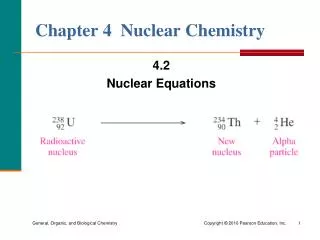
Nuclear Equations – sum of both mass and atomic numbers on both sides of equation are equal Examples: 6831Ga + 0-1e → _____ 21287Fr → 20885At + ______ 263106Sg → ______ + 42He
21.4 Rates of Radioactive Decay • Radioactive decay follows 1st order kinetics. • All half-lives are equal. N – # of radioactive nuclei k – decay constant Individual half-lives vary tremendously 214Po 2 x 10⁻⁴ s 144Nd 5 x 10¹⁵ year