Understanding pH, Ionization of Water, and Acid-Base Concentrations
This text explores the concepts of acids and bases, focusing on the ionization of water and its relationship to pH and hydroxide ion concentration. It details the calculations for determining the pH of solutions like HCl and HNO3, as well as finding the molarity of strong acids such as HBr through given pH and pOH values. It explains the pH scale, where values below 7 indicate acidity and values above 7 indicate basicity, alongside the fundamental relationship of pH and pOH in aqueous solutions.

Understanding pH, Ionization of Water, and Acid-Base Concentrations
E N D
Presentation Transcript
Ch. 14 & 15 - Acids & Bases II. pH
H2O + H2O H3O+ + OH- A. Ionization of Water Kw = [H3O+][OH-] = 1.0 10-14
A. Ionization of Water • Find the hydroxide ion concentration of 3.0 10-2 M HCl. [H3O+][OH-] = 1.0 10-14 [3.0 10-2][OH-] = 1.0 10-14 [OH-] = 3.3 10-13 M Acidic or basic? Acidic
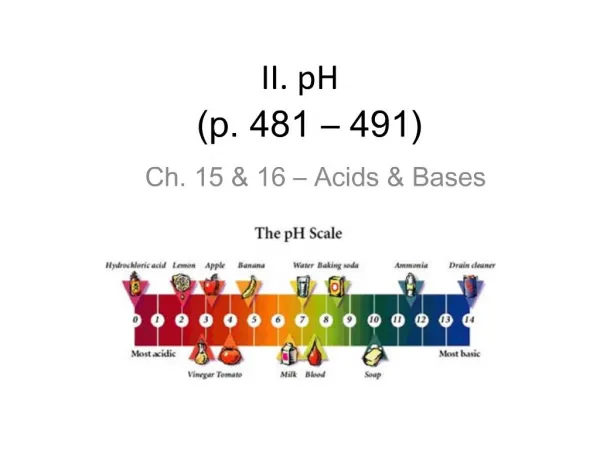
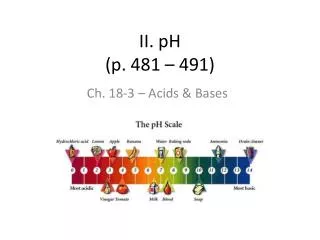
pouvoir hydrogène (Fr.) “hydrogen power” B. pH Scale 14 0 7 INCREASING BASICITY INCREASING ACIDITY NEUTRAL pH = -log[H3O+]
B. pH Scale pH of Common Substances
B. pH Scale pH = -log[H3O+] pOH = -log[OH-] pH + pOH = 14
B. pH Scale • What is the pH of 0.050 M HNO3? pH = -log[H3O+] pH = -log[0.050] pH = 1.3 Acidic or basic? Acidic
B. pH Scale • What is the molarity of HBr in a solution that has a pOH of 9.6? pH + pOH = 14 pH + 9.6 = 14 pH = 4.4 pH = -log[H3O+] 4.4 = -log[H3O+] -4.4 = log[H3O+] [H3O+] = 4.0 10-5 M HBr Acidic