Primitive Recursive Functions in Mathematics
190 likes | 220 Views
Learn about the concepts of primitive recursion, addition, multiplication, pairing functions, minimization, and more in mathematics. Understand the principles of recursive functions and their applications.


Primitive Recursive Functions in Mathematics
E N D
Presentation Transcript
Initial Functions • Zero function ζ(n) = 0. • Successor σ(n) = n+1, for n ε N. • Projectionπi (n1,…,nk) = ni. k
Composition • Let m, k be two integers. • Given functions g: N → N and hi: N → N for I = 1, 2, …, m, define f: N → by f(n1,…,nk) = g(h1(n1,…,nk),…,hm(n1,…,nk) • f is called thecompositionof g and h1, …,hm. • f = go(h1,…,hm) m k k
Primitive Recursion k k+2 • Let k > 0. Given g: N → N and h: N → N, (when k=0, g is a constant), define f : N → N by f(n1,…nk,0) = g(n1,…,nk) f(n1,…,nk,m+1) = h(n1,…,nk,m,f(n1,…nk,m) k+1
Primitive Recursive Functions • All initial functions are primitive recursive. • If g and h1, …, hm are primitive recursive, so is go(h1, …, hk). • If g and h are primitive recursive, so is f obtained from g and h by primitive recursion. • Nothing else is primitive recursive.
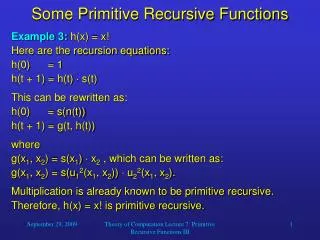
Add(m, n) = m+n • Add(m,0) = π1 (m) • Add(m, n+1) = σ( π3 (m,n, add(m, n))) 1 3
mult(m, n) = mn • mult(m, 0) = ζ(m) • Mult(m, n+1) = add(π1(m,n,mult(m,n)), π3(m, n, mult(m,n)) 1 3
minus(m,n)= m-n if m > n; 0 if m<n • pred(m) = minus(m,1) pred(0) = ζ(0) pred(m+1) = m = π1 (m, pred(m)) • minus(m,0) = π1 (m) minus(m, n+1) = pred(π3(m,n,minus(m, n)) 2 1 3
Pairing Function • A function f: N → N is a pairing function if it satisfies the following conditions: (1) f is 1-to-1 and onto; (2) f is primitive recursive; (3) f(i, j) < f(i+1, j), f(i, j) < f(i, j+1). • For example,
Two “inverse” functions i = g(f(i,j)) and j = h(f(i, j)) are also primitive recursive. 14 13 9 8 5 12 2 4 7 11 0 1 3 6 10
Bounded minimization K+1 • Given g: N → N, define f by f(n1, …, nk, m) = min {i | g(n1, …, nk, i)=1} if there exists i < m such that g(n1, …, nk, i) =1; = 0, otherwise. • If g is primitive recursive, so is f.
Unbounded minimization K+1 • Given g: N → N, define f by f(n1, …, nk) = min {i | g(n1, …, nk, i)=1} if there exists i such that g(n1, …, nk, i) =1; = ↑, otherwise. • f may not be primitive recursive, even if g is.
Partial Recursive Functions • All initial functions are partial recursive. • If g is a total recursive function, then f obtained from g by unbounded minimization is partial recursive. • If g and h1,…, hk are partial recursive, so is go(h1,…,hk). • If g and h are partial recursive, so is f obtained from g and h by primitive recursion.
Over Σ* • Zero function ζ(x) = ε. • Successor σa(x) = xa for a in Σ. • Projection (no change) • Composition (no change) • Primitive recursion (need a change, m+1 is replaced by ma) • Unbounded minimization (need to give a linear ordering of Σ*)
From Σ* to Γ* for Σ* cΓ* • Zero function ζ(x) = ε. • Successor σa(x) = xa for a in Γ. • N can be considered as a subset of {0, 1}* if we represent n by 1…1 n
Theorem • A function is partial recursive iff it is Turing-computable.
Theorem The following are equivalent: • A is r.e. • A is Turing-acceptable. • A is the range of a primitive recursive function. • A is the domain of a partial recursive function.
Pairing function on Σ* • Let π(i, j) be a pairing function on N. • Let φ be a 1-to-1 onto mapping from N to Σ*. • Let μ be a 1-to-1 onto mapping from Σ* to N. • Then p(x, y) = φ(π(μ(x), μ(y)) is a pairing function on Σ*.