An Introduction to Risk Based Auditing
150 likes | 286 Views
This document provides a concise overview of risk-based auditing, focusing on its objectives and processes as outlined in ISA/CAS 200. Auditors are guided through a three-step audit process: risk assessment, risk response, and reporting. The goal is to ensure financial statements are free from material misstatement. Essential audit requirements include ethical compliance and the need for professional skepticism. Practical tools such as risk/control assessment forms are discussed, along with resources for further training and support available through FocusROI.


An Introduction to Risk Based Auditing
E N D
Presentation Transcript
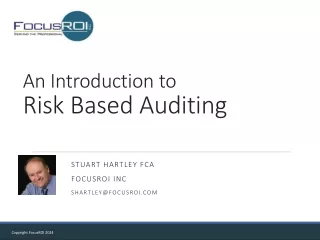
An Introduction to Risk Based Auditing Stuart Hartley FCA FocusROI Inc shartley@focusroi.com
The Audit Objective (ISA/CAS 200) • To obtain reasonable assurance about whether the financial statements as a whole are free from material misstatement, whether due to fraud or error, thereby enabling • the auditor to express an opinion on whether the financial statements are prepared, in all material respects, in accordance with an applicable financial reporting framework;
The Audit Process - in 3 steps • Risk assessment – What can go wrong? • Perform risk assessment procedures to identify and assess the risks of material misstatement in the financial statements. • Risk Response– Did it go wrong? • Perform further procedures to respond to the assessed risks and determine if material misstatements have occurred. • Reporting. – Opinion • What is the appropriate wording of the audit opinion based on the work performed?
Basic Audit Requirements ISA/CAS 200 • Comply with relevant ethical requirements, • Plan and perform an audit with professional skepticism • Exercise professional judgment in planning and performing an audit • Obtain sufficient appropriate audit evidence to reduce audit riskto an acceptably low level • Comply with all CASs relevant to the audit
Pervasive vs Transactional The foundation
Scope of Risk/Control Assessment – Consider using the 3 risk/control Categories Entity Specific Pervasive Transactional C-PEM Form 520/522 C-PEM Form 530 C-PEM Form 540 - 560
Identifying and Assessing Risk Document Results Assess RMM
Pervasive Transactions Entity Specific Pervasive Transactional risks/controls (account balance) risks/controls Use of Professional Judgment to assess RMM Assertion F/S Level Level Categories of Risk and Control Risk Assessments
CPEM 2014 • A practical approach to auditing • The Canadian Professional Engagement Manual • Published by CPA Canada • http://www.castore.ca/product/canadian-professional-engagement-manual-members/5
FocusROI Services • In house and web based Training • Quality Control Monitoring • Small group Coaching www.focusroi.com 416 594 0005 info@focusroi.com
Please contact us for further informationinfo@focusROI.com416 594 0005