Exploring Colin Martindale’s Influence: The Muse and the Clockwork in Literary Change
390 likes | 537 Views
This retrospective review examines Colin Martindale’s magnum opus, "The Muse and the Clockwork," highlighting his variation-selection model inspired by Darwinian principles. The work explores the natural and adaptive success of literary trends through stylistic changes in poetry, short stories, and pop lyrics. By analyzing primary processes of creativity and their implications on arousal potential, it reveals insights into literary evolution and the relationship between cognitive psychology and the arts.


Exploring Colin Martindale’s Influence: The Muse and the Clockwork in Literary Change
E N D
Presentation Transcript
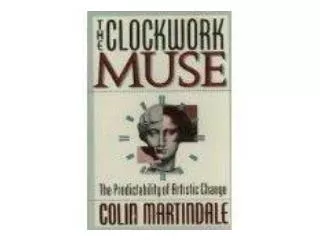
The Muse and the Clockwork in the Clockwork Muse A Retrospective Review of Colin Martindale’s Magnum Opus
The Raw Data Stylistic Change
The Muse • Colin’s theory • Variation-selection model a la Darwin • Selection • Natural adaptive success • Sexual hedonic value • Variation • Regression: Maximize primary process • Elaboration: Minimize secondary process
The Muse • Implications: Trends in • Arousal potential • Primary process • Stylistic change
The Clockwork • The research: Literary change • Content analytical studies • Poetry
The Clockwork • The research: Literary change • Content analytical studies • Poetry • Short stories
The Clockwork • The research: Literary change • Content analytical studies • Poetry • Short stories • Lyrics for popular songs
The Clockwork • The research: Literary change • Content analytical studies • Poetry • Short stories • Lyrics for popular songs • Literary criticism
The Clockwork • The research: Literary change • Content analytical studies • Experimental simulation
the sea, quiet a horizontal wall a formicaed [sic] bed the platonic form a dead tree a listening board versatile friendship vanquished forest a seasoned man two chairs A table is like _____
A pencil is like ____ • a yellow cigarette, spreading its cancer on paper • the headwaters of a river, flowing from the mind to the world • a black light on nothing • a stiletto, piercing truth • an artist’s brush, painting paper • an ice scraper, unfreezing one’s view of the world
A pencil is like ____ • the scratchy fingers of an insomniac • a grenade: useful, destructive, yet often self-destructive • the neck of an hourglass • God micturating upon the cosmos
The Clockwork • TAT stories
The Clockwork • And beyond …
Jean Baptiste Greuze The Village Bride 1761 photographic and realistic
Gustave Moreau Oedipus and the Sphinx 1864 photographic but not realistic
Yves Tanguy Mama, Papa Is Wounded! 1927 even less realistic
Jackson Pollock Autumn Rhythm 1950 neither photographic nor realistic
Cognitive Psychology Behaviorism
But … • What about?