Evaluating Oxfam GB's Global Climate Change Campaign: A Framework for Impact Assessment
This analysis evaluates Oxfam GB's Global Climate Change Campaign, addressing the challenges of assessing value for money in complex, multi-unit international campaigns. The BER solution offers a simplified framework that builds upon the Social Return on Investment (SROI) concept, allowing for a relative assessment of performance among peer units. By utilizing matrix analysis and other theoretical foundations, the approach guides organizations in evaluating program impacts compared to resources. The study includes fictional case examples, measurement tools, and visualization strategies to facilitate interpretation and discussion.

Evaluating Oxfam GB's Global Climate Change Campaign: A Framework for Impact Assessment
E N D
Presentation Transcript
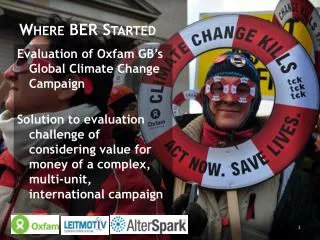
Where BER Started • Evaluation of Oxfam GB’s Global Climate Change Campaign • Solution to evaluation challenge of considering value for money of a complex, multi-unit, international campaign
Evaluation challenges • Simplifying complex multi-unit programs • Many evaluations are about ROI, but ROI is difficult to assess in social contexts • Nothing is good or bad, except in comparison to something else
The BER Solution • Provide a simple framework for evaluating complex multi-component programs, campaigns, or activities • Build on the basic concepts of SROI to evaluate unit's impact compared to their resources • Offers a relative perspective on performance where units of analysis are judged in comparison to their peer units, operating under similar conditions
Theoretical Foundations: Matrix analysis frameworks • Boston Consulting Group • General Electric Grid • Customer satisfaction quadrant analysis by Andreasen • Bloc modeling techniques used by social network analysts • Multi dimensional scaling • SROI
BER Variables • input constitutes a program’s resources which may be measured by its budget, number of staff, pool of talent, social capital, or any measure of capacity, concrete or abstract. Output measures a program’s impact, and will vary according to a program's purpose – may include behaviour change; public awareness; policy change; reduced inequality; improved environmental health… or any other measure depending on a program's goals
Conducting a BER Analysis The example in following section is fictional and for illustrative purposes.
1. Selecting units of analysis For example: Coalition/partnership building; intra organisational coordination; lobbying and advocacy; media relations; online engagment; public mobilization; research...
2. Data types • Quantitative input data may include budgets, number of staff, or combined multi-dimensional resource measure • Quantitative output data may include process evaluation measures such as the number of people engaged by a campaign or media hits • Qualitative measures can include perceived program investments and perceived output achieved
3. Measurement tools Organisation X has influenced policies or legislation because of the following activities:
4. Visualization approaches High Low High Low
Case Study: Oxfam GB’s Global Climate Change Campaign High Perceived impact Low Low High Perceived resourcing
5. Interpretation • Use BER is as a starting point for deeper discussions into the performance of intervention units, their challenges, opportunities, and operating environment • Understand the units of analysis and the informants who shared their perceptions • Not all units within a program operate under the same conditions • Some units contribute indirect effects, by empowering other units
Limitations and Risks • It is easy to draw conclusions from the simple visualizations that would never stand in the face of a deeper understanding of the reality behind charts • Kotler et al. (2005) noted, reliance on matrix approaches prompted a number of companies to sell off strategic assets and plunge into businesses that they lacked the experience to manage