Understanding Enzymes: Structure, Function, and Factors Affecting Activity
This chapter explores the significance and functions of enzymes in biological systems. It covers enzyme structure, including specificity related to active sites, and the necessity of activation energy to initiate spontaneous reactions. The text explains how enzymes catalyze reactions and discusses factors influencing enzymatic function, including substrate concentration, pH, temperature, salinity, and the role of coenzymes. Various inhibition types, including competitive and non-competitive inhibition, are examined, alongside the concept of feedback inhibition and designing labs to measure environmental effects on enzyme activity.

Understanding Enzymes: Structure, Function, and Factors Affecting Activity
E N D
Presentation Transcript
Enzymes Chapter 8
Learning Targets • I can describe the structure and explain the significance and functions of enzymes in biological systems • I can describe why an investment of activation energy is necessary to initiate a spontaneous reaction. • I can explain how enzymes speed up chemical reactions. • I can explain the interactions between substrates and active sites of enzymes. • I can explain how the following affect enzymatic function: • Enzyme and substrate concentrations • pH, temperature and salinity • coenzymes • inhibition; competitive, non-competitive and allosteric cooperativity • I can describe the role that enzymes play in feedback inhibition. • I can design a lab that quantifiably measures the effect of an environmental factor on enzymatic activity.
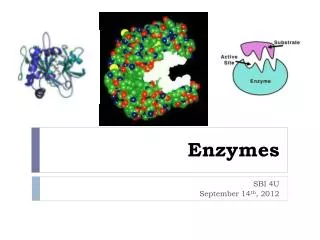
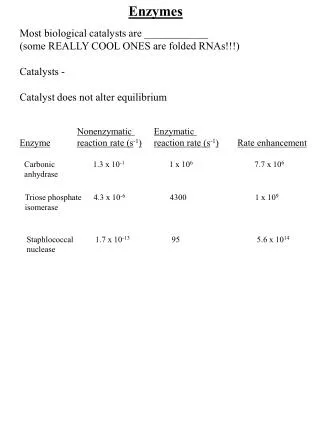
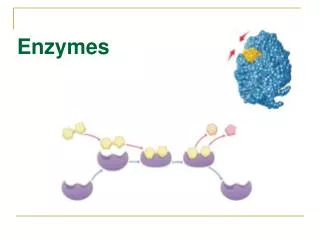
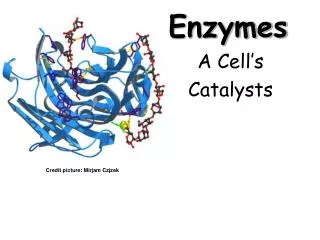
Structure • Protein • Each enzyme is substrate-specific: the active site is specifically shaped so only certain molecules fit on it
Learning Targets • I can describe the structure and explain the significance and functions of enzymes in biological systems • I can describe why an investment of activation energy is necessary to initiate a spontaneous reaction. • I can explain how enzymes speed up chemical reactions. • I can explain the interactions between substrates and active sites of enzymes. • I can explain how the following affect enzymatic function: • Enzyme and substrate concentrations • pH, temperature and salinity • coenzymes • inhibition; competitive, non-competitive and allosteric cooperativity • I can describe the role that enzymes play in feedback inhibition. • I can design a lab that quantifiably measures the effect of an environmental factor on enzymatic activity.
Activation Energy • How reactions work:
Learning Targets • I can describe the structure and explain the significance and functions of enzymes in biological systems • I can describe why an investment of activation energy is necessary to initiate a spontaneous reaction. • I can explain how enzymes speed up chemical reactions. • I can explain the interactions between substrates and active sites of enzymes. • I can explain how the following affect enzymatic function: • Enzyme and substrate concentrations • pH, temperature and salinity • coenzymes • inhibition; competitive, non-competitive and allosteric cooperativity • I can describe the role that enzymes play in feedback inhibition. • I can design a lab that quantifiably measures the effect of an environmental factor on enzymatic activity.
Induced Fit • Shape of active site can change slightly as substrate binds • The active site is then molded into a precise conformation--sort of like a hand in a glove • So, some enzymes canact on similarmolecules, not justspecificones
Learning Targets • I can describe the structure and explain the significance and functions of enzymes in biological systems • I can describe why an investment of activation energy is necessary to initiate a spontaneous reaction. • I can explain how enzymes speed up chemical reactions. • I can explain the interactions between substrates and active sites of enzymes. • I can explain how the following affect enzymatic function: • Enzyme and substrate concentrations • pH, temperature and salinity • coenzymes • inhibition; competitive, non-competitive and allosteric cooperativity • I can describe the role that enzymes play in feedback inhibition. • I can design a lab that quantifiably measures the effect of an environmental factor on enzymatic activity.
Enzyme-Substrate Interaction • How do the following relate to enzymes? • active site • substrate • induced fit • energy of activation
Learning Targets • I can describe the structure and explain the significance and functions of enzymes in biological systems • I can describe why an investment of activation energy is necessary to initiate a spontaneous reaction. • I can explain how enzymes speed up chemical reactions. • I can explain the interactions between substrates and active sites of enzymes. • I can explain how the following affect enzymatic function: • Enzyme and substrate concentrations • pH, temperature and salinity • coenzymes • inhibition; competitive, non-competitive and allosteric cooperativity • I can describe the role that enzymes play in feedback inhibition. • I can design a lab that quantifiably measures the effect of an environmental factor on enzymatic activity.
Enzyme-Substrate Concentration • Enzymes act on one molecule at a time • Reach a saturation point when all enzymes are engaged in reaction
pH, Temperature, Salinity • All enzymes have a specific range for optimal performance • Outside of that range denature don’t function
Inhibiting Factors Prevent/Interfere with Enzyme Function
Competitive Inhibition • Competitive inhibitor has same shape as substrate • (competes for active site) • Prevents substrate from binding to active site by binding to active site itself
Allosteric Inhibition • Inhibitor binds to allosteric site of enzyme • Active site changes shape, no substrate binds
Enhancing Factors Help/Increase Enzyme Function
Cofactors & Coenzymes • Cofactor assist with catalytic activities of enzyme • Coenzyme is an organic cofactor • Ex: vitamins
Allosteric Activation • Change in the enzyme’s shape due to binding of activator at allosteric site • Enzyme is stabilized by activator
Allosteric Cooperativity • One substrate molecule primes an enzyme to receive more substrates readily • Ex: hemoglobin
Learning Targets • I can describe the structure and explain the significance and functions of enzymes in biological systems • I can describe why an investment of activation energy is necessary to initiate a spontaneous reaction. • I can explain how enzymes speed up chemical reactions. • I can explain the interactions between substrates and active sites of enzymes. • I can explain how the following affect enzymatic function: • Enzyme and substrate concentrations • pH, temperature and salinity • coenzymes • inhibition; competitive, non-competitive and allosteric cooperativity • I can describe the role that enzymes play in feedback inhibition. • I can design a lab that quantifiably measures the effect of an environmental factor on enzymatic activity.
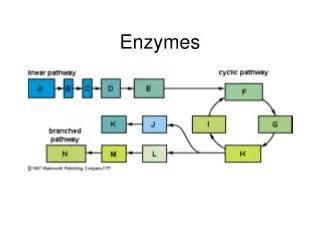
Feedback Inhibition • The switching off of a biochemical pathway by the product of the pathway • Negative feedback • Conserve energy!
Learning Targets • I can describe the structure and explain the significance and functions of enzymes in biological systems • I can describe why an investment of activation energy is necessary to initiate a spontaneous reaction. • I can explain how enzymes speed up chemical reactions. • I can explain the interactions between substrates and active sites of enzymes. • I can explain how the following affect enzymatic function: • Enzyme and substrate concentrations • pH, temperature and salinity • coenzymes • inhibition; competitive, non-competitive and allosteric cooperativity • I can describe the role that enzymes play in feedback inhibition. • I can design a lab that quantifiably measures the effect of an environmental factor on enzymatic activity.
AP Lab 13 • Bozeman video