Download
1 / 9
90 likes | 220 Views
This document outlines Sweden's comprehensive policy for global development, established in 2003, with a 40-year history of development cooperation. The policy aims to promote equitable and sustainable global development through policy coherence across all areas, focusing on human rights, democracy, gender equality, and the sustainable use of natural resources. It emphasizes the importance of respecting the perspectives of the poor and supporting their efforts to enhance their quality of life. The policy also highlights increased efficiency in development cooperation and collaboration with various stakeholders.

E N D
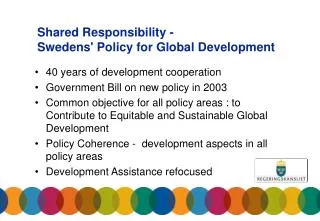
Shared Responsibility -Swedens' Policy for Global Development • 40 years of development cooperation • Government Bill on new policy in 2003 • Common objective for all policy areas : to Contribute to Equitable and Sustainable Global Development • Policy Coherence - development aspects in all policy areas • Development Assistance refocused
Policy Coherence • A Common Global Agenda: - UN Millennium Declaration and Millennium Development Goals - Doha, Monterrey and Johannesburg conferences • All government ministries involved in forming the new policy: - Legal, security and defence, trade, migration, social, economic, agriculture, culture, environment, employment etc.
Two Basic Perspectives • A Rights Perspective - All human beings are born free and equal in dignity and rights - Democracy and human rights reinforce each other • The perspectives of poor people - Priorities of the poor - Poverty reduction strategies
Central Elements of the Policy • Respect for human rights • Democracy and good governance • Gender equality • Sustainable use of natural resources and environmental protection • Economic growth • Social development and social security • Conflict management and human security • Global public goods
A New Focus for Swedish Development Cooperation • Objective : To contribute to an environment supportive of poor people's own efforts to improve their quality of life • Development cooperation is a complement to partner countries' and counterparts' own efforts
Increased Efficiency of Development Cooperation • Concentration to fewer sectors and areas • Increased cooperation and coordination with other donors, international organisations, civil society etc. • No sharp division between bilateral and multilateral assistance • Harmonisation of procedures and routines • Untying of development assistance • 1 percent of GNP in aid
Policy Coherence - Implementation • Government level: - Policy Coherence Unit, Ministry for Foreign Affairs - Annual Report to the Parliament on the implementation of the policy for global development - MDG 8 Report • Involvement of civil society and the private sector - a Citizens’ Forum to be created • Independent Evaluation Function • Further research and analysis in areas like GPG, migration, security, agriculture,trade etc.
Global Public Goods (GPG) • International Task Force on GPG - Defining International Public Goods - Priorities in the provision of international public goods: selection of key issues, management and financing - Recommendations for future actions
Policy Coherence Research by EGDI (Expert Group on Development Issues) • Migration and Development • Security and Development • Linking Informal and Formal Sectors • Special and Differential Treatment of Developing Countries in the WTO • A Multilateral System fit for Financing Development • International research cooperation on “Development Impact of Rich Countries Policies” • www.egdi.gov.se