Power Functions and Polynomials Fundamentals
Learn about power functions, special power functions, symmetry, polynomials, their properties, zeros, and methods for finding zeros in this comprehensive lesson. Explore exercises to reinforce your understanding.

Power Functions and Polynomials Fundamentals
E N D
Presentation Transcript
Polynomial Functions Lesson 9.2
Power Function • Definition • Recall from the chapter on shifting and stretching, what effect the k will have? • Vertical stretch or compression for k < 1
Special Power Functions • Parabola y = x2 • Cubic function y = x3 • Hyperbola y = x-1
Special Power Functions • y = x-2
Special Power Functions • Most power functions are similar to one of these six • xp with even powers of p are similar to x2 • xp with negative odd powers of p are similar to x -1 • xp with negative even powers of p are similar to x -2 • Which of the functions have symmetry? • What kind of symmetry?
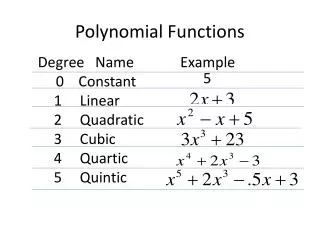
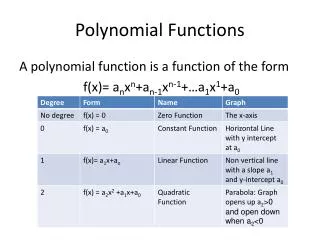
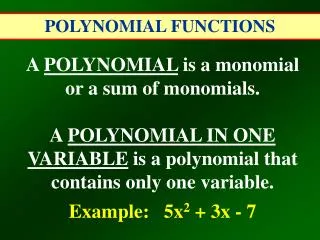
Polynomials • Definition: • The sum of one or more power function • Each power is a non negative integer
Polynomials • General formula • a0, a1, … ,an are constant coefficients • n is the degree of the polynomial • Standard form is for descending powers of x • anxn is said to be the “leading term”
Polynomial Properties • Consider what happens when x gets very large negative or positive • Called “end behavior” • Also “long-run” behavior • Basically the leading term anxn takes over • Comparef(x) = x3 with g(x) = x3 + x2 • Look at tables • Use standard zoom, then zoom out
Polynomial Properties • Compare tables for low, high values
The leading term x3 takes over For 0 < x < 500the graphs are essentially the same Polynomial Properties • Compare graphs ( -10 < x < 10)
Zeros of Polynomials • We seek values of x for which p(x) = 0 • We have the quadratic formula • There is a cubic formula, a quartic formula
Zeros of Polynomials • We will use other methods • Consider • What is the end behavior? • What is q(0) = ? • How does this tell us that we can expect at least two roots?
Methods for Finding Zeros • Graph and ask for x-axis intercepts • Use solve(y1(x)=0,x) • Use zeros(y1(x),x) • When complex roots exist, use cSolve() or cZeros()
Practice • Giveny = (x + 4)(2x – 3)(5 – x) • What is the degree? • How many terms does it have? • What is the long run behavior? • f(x) = x3 +x + 1 is invertible (has an inverse) • How can you tell? • Find f(0.5) and f -1(0.5)
Assignment • Lesson 9.2 • Page 400 • Exercises 1 – 29 odd