Download
1 / 16
160 likes | 332 Views
Explore the concept of weather fronts and their significance in meteorology. This guide covers the three main types of fronts: cold fronts, warm fronts, and stationary fronts, detailing their characteristics and impacts on temperature and stability. Learn how to identify and analyze surface weather maps, including pressure and temperature variations, along with wind direction indicators. Enhance your understanding of how these atmospheric phenomena influence weather patterns and change in conditions.

E N D
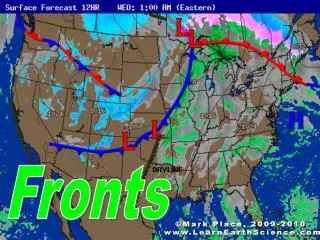
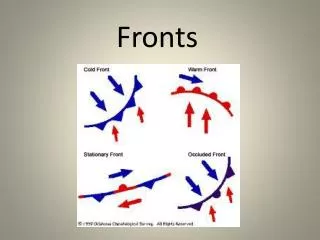
Types of Fronts • Now that we have learned the concepts of density, we can better understand what fronts are and how they affect the weather. • Cold Front: A transition zone where cold/dry, and stable air, replaces warm/moist, and unstable air. It is depicted by a blue line with triangles pointing towards the direction of movement.
Cold Front Colder Temperatures 27 54 33 Warmer Temperatures 62
Cold Front (Vertical Profile) Advancing Cold air Rising Warm air
Warm Front Colder Temperatures 45 Warm Front 38 55 Warmer Temperatures 62
Warm Front (Vertical Profile) Warm air Cold air
Stationary Front Cold Air Warm Air
Mapping Exercise • Draw and analyze a surface weather map for pressure and temperature, and draw the fronts that are indicated by these two variables.
Wind directionThe wind barb (parts ff and dd combined) is like an arrow and points in the direction the wind is blowing. The suffix -erly means the wind is blowing from that direction. Here are a few examples of how to describe wind direction: