Understanding Mitosis: Processes, Differences in Plants and Animals
290 likes | 390 Views
Mitosis is the process by which a cell's nucleus divides, resulting in the formation of two new nuclei. This essential mechanism underpins asexual reproduction, allowing organisms to grow, repair, and replace cells. In this lesson, we will explore how mitosis differs between plant and animal cells, highlighting key phases such as prophase, metaphase, anaphase, telophase, and cytokinesis. Understanding these differences is crucial for comprehending the broader concepts of life science and cellular reproduction.


Understanding Mitosis: Processes, Differences in Plants and Animals
E N D
Presentation Transcript
Asexual Reproduction Mitosis DSQ: Mitosis is the process in which the nucleus divides to form two new nuclei. How does mitosis differ in plants and animals? Mrs. Camp 7th Grade Life Science 1
Ready? Begin!
4:00 DSQ: Mitosis is the process in which the nucleus divides to form two new nuclei. How does mitosis differ in plants and animals?
3:00 DSQ: Mitosis is the process in which the nucleus divides to form two new nuclei. How does mitosis differ in plants and animals?
2:00 DSQ: Mitosis is the process in which the nucleus divides to form two new nuclei. How does mitosis differ in plants and animals?
1:00 DSQ: Mitosis is the process in which the nucleus divides to form two new nuclei. How does mitosis differ in plants and animals?
Asexual Reproduction Mitosis DSQ: Mitosis is the process in which the nucleus divides to form two new nuclei. How does mitosis differ in plants and animals? ANALYZE (break apart, study the pieces) There is a question within a question in this DSQ. Can you identify the question within the DSQ? 8
The process of asexual reproduction (cell cycle) begins after a sperm fertilizes an egg.
Three reasons why cells reproduce by asexual reproduction: 1. Growth 2. Repair 3. Replacement Skin cancer - the abnormal growth of skin cells - most often develops on skin exposed to the sun. Cell that reproduce by asexual reproduction reproduce constantly.
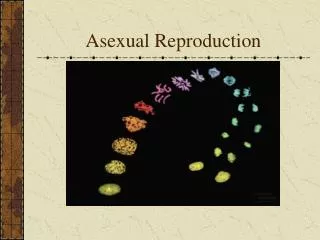
Animated Mitosis Cycle http://www.cellsalive.com/mitosis.htm • Interphase • M1- Prophase • M2- Metaphase • M3- Anaphase • M4- Telophase • Cytokinesis
Interphaseoccurs before mitosis begins • Chromosomes and all organelles are copied. • Chromosomes appear as threadlike coils (chromatin) at the start, but are almost invisible with a light microscope. CELL MEMBRANE Nucleus Cytoplasm
InterphaseWhat differences do you see? Plant Cell Animal Cell Photographs from: http://www.bioweb.uncc.edu/biol1110/Stages.htm
M1- Prophase 1st step in Mitosis • Mitosis begins. Chromosomes visible. • Centrioles(or poles) appear and begin to move to opposite end of the cell. (Not in Plants) • Spindle fibers form between the poles. Centrioles Sister chromatids Spindle fibers
M1- ProphaseWhat differences do you see? Plant Cell Animal Cell Spindle fibers Photographs from: http://www.bioweb.uncc.edu/biol1110/Stages.htm
M2- Metaphase 2nd step in Mitosis • Chromatids (or pairs of chromosomes) attach to the spindle fibers in middle of cell. Centrioles Spindle fibers
M2- MetaphaseWhat differences do you see? Plant Cell Animal Cell Photographs from: http://www.bioweb.uncc.edu/biol1110/Stages.htm
M3- Anaphase 3rdstep in Mitosis • Chromatids (or pairs of chromosomes) separate and begin to move toward opposite ends of the cell. Centrioles Spindle fibers
AnaphaseWhat differences do you see? Plant Cell Animal Cell Photographs from: http://www.bioweb.uncc.edu/biol1110/Stages.htm
Telophase4th step in Mitosis • Chromosomes are at across ends of cell. • Chromosomes appear as chromatin (threads rather than rods). • Two new nuclei form • Mitosis ends. Nuclei Nuclei Chromatin
TelophaseWhat differences do you see? Plant Cell Animal Cell Photographs from: http://www.bioweb.uncc.edu/biol1110/Stages.htm
Cytokinesisoccurs after mitosis • Cell membrane moves inward to create two daughter cells – each with its own nucleus with identical chromosomes.
The Cell Cycle - Cell Division 29
MitosisAnimation http://www.cellsalive.com/mitosis.htm