TIGERBOT MECHANICAL DESIGN
This document outlines the mechanical design of a robotic system featuring 2 Degrees of Freedom (DOF) in the head, 4 DOF in the arm, 1 DOF in the torso, and 6 DOF in the legs. The overall height is approximately 25.5 inches, with customizable torso and shoulder widths. Key components include simple aluminum brackets for mounting, adjustable arm assemblies, and ball bearing integration for improved performance. A thorough stress analysis is provided, along with torque requirements and mechanical risk assessments. The design emphasizes adjustability, durability, and cost-effectiveness.

TIGERBOT MECHANICAL DESIGN
E N D
Presentation Transcript
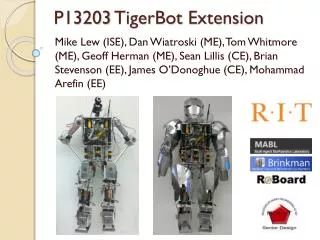
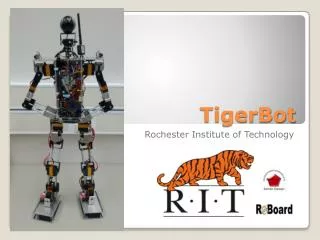
TIGERBOT MECHANICAL DESIGN Kyle Backer (EE), Jeremy Jensen (ME), Matthew DeCapua (EE), Eric Walkama (ME), Mike Thomas (EE), Jonathan Cormier (CE), John Seybold (CE)
2 DOF in Head • 4 DOF/Arm • 1 DOF in Torso • 6 DOF/ Leg Overview
~25.5” Tall (feet to shoulder) • 10” Shoulder Width • 2.5” Torso Width BODY DIMENSIONS
4 Simple brackets for multiple servo mounting orientations • Side mount • Bottom mount • Large “C” bracket • Single plane dual axis rotation • Shoulder Rotation Side Mount Bottom Mount Large “C” Custom Servo Brackets Shoulder Rotation
Simple Aluminum rods, ¼” • Cut to length Height adjustability • Very cheap (~$7 per 6ft) • Integrates into standard servo brackets. Arm Assembly Custom Brackets Store bought Brackets Simple 6-32x1/2” machine screws for assembly LINKS & BRACKET INTEGRATION
Ball Bearing • Axial and Radial Loads • Low rotation friction • Ball Bearings are cheap • Reduce stress on servo horn • Increased hip Stiffness -Green Rotation -Gray Static HIP DESIGN
Leg Lift Squat T3 Push up T3 T2 Te Te T1 (cos(ϴ))+g1(L1/2)(cos(ϴ)) T2=(g2)(L2/2)(cos(ϴ))+(L2)(g3) T3~0 TORQUE REQUIREMENTS F F/2 F/2
ROBOARD SERVO SPECS • Standard size digital servo• Torque @7.4V: 35.0 kg-cm/486.0 oz-in• Speed: 0.11 sec/60º• Voltage: 6 to 7.4V • Weight: 70g TORQUE RESULTS
Breaking on fall • Easily and cheaply replaceable frame • Insufficient torque • Adjustable height • Wire routing • Open skeleton design, adjustable chest volume • Boards shorting • Large board spacing, easy addition of insulation layer in chest Mechanical System Risks