COLONIAL AMERICA
This overview delves into the critical aspects of Colonial America, focusing on its regions: New England, Middle, Chesapeake, and Southern colonies. Explore the founding principles of Puritanism in New England, the agricultural pursuits and social divisions in the Southern colonies, and the religious tolerances established in the Middle colonies. Significant events leading to the American Revolution, including taxation without representation and the Declaration of Independence, are examined, providing a comprehensive understanding of early American governance and society.


COLONIAL AMERICA
E N D
Presentation Transcript
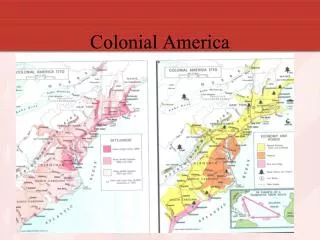
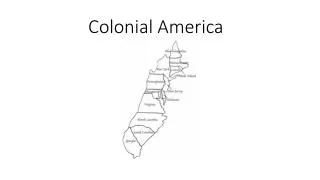
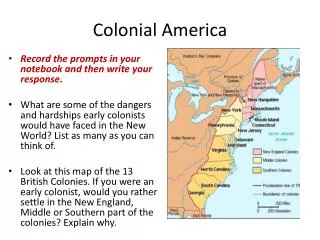
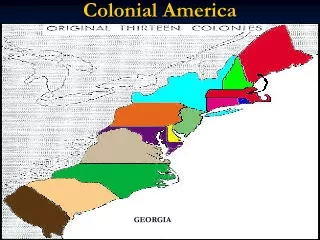
NEW ENGLAND COLONIES • MASSACHUSETTS • NEW HAMPSHIRE • CONNECTICUT • RHODE ISLAND
KEY FACTS: • The first New England colonies were established by the Puritans who were quite intolerant • Communities were often run by town meetings unless the King had established control over the colony • Remember the ‘PURITAN WORK ETHIC’
Colonies controlled by the king had an appointed royal governor and partially elected legislature • The region could not support large scale agriculture so it’s economy was based on TRADE, SHIPPING, LUMBER, AND SHIPBUILDING
NEW ENGLAND COLONIES • RI founded by Roger Williams who was expelled from MA for religious dissention and was more tolerant of other religions
MIDDLE AND CHESAPEAKECOLONIES • NY and NJ were under royal control. • PA was a proprietary colony (land was given by king to William Penn who had tremendous power and authority in the colony)
MIDDLE AND CHESAPEAKECOLONIES • PA was a religiously tolerant colony (Quakers) • NY was a center for trade and commerce. It was also religiously tolerant b/c of its diverse • MD was a proprietary colony under Lord Baltimore and wanted it to be a haven for English Catholics
MIDDLE AND CHESAPEAKECOLONIES • NY, NJ, and PA could also support agriculture and were relatively rural • MD, DE, and VA were all dependant upon agriculture • MD and VA depended upon TOBACCO • Great social divisions between those who owned land and those who didn’t • Agricultural colonies were labor intensive and required large labor source (SLAVERY)
SOUTHERN COLONIES • NORTH CAROLINA • SOUTH CAROLINA • GEORGIA
SOUTHERN COLONIES • Primarily agricultural economies • NC had tobacco and lumber • SC had rice • Slavery was used in great numbers
SOUTHERN COLONIES • GA originally outlawed slavery • GA was also a debtor’s and penal colony where people could go to work off debts or could be sent to be reformed. • Social classes were strictly defined, especially in SC
CAUSES OF THE REVOLUTION • VIOLATIONS OF COLONISTS RIGHTS: • Taxation without representation • No fair trials by jury • Protection from unfair search and seizure • Protection from being forced to quarter troops
STAMP ACT • Act required colonists to print newspapers, legal documents, playing cards, etc on special stamped paper. Buying this paper was equivalent to paying a tax. • SONS OF LIBERTY protested. Nine colonies formed the STAMP ACT CONGRESS to formally protest to the king.
TOWNSHEND ACT • Increased taxed on imports to raise money to pay royal governors. • This would free governors from local control. • Many colonists boycotted and maintained some control.
TEA ACT • Removed tax on all imports EXCEPT TEA. Sons of Liberty staged the BOSTON TEA PARTY
INTOLERABLE ACTS • Punishment for the Boston Tea Party. • Closed port of Boston. • Allowed British officials accused of crimes to be tried in England. • Forced the quartering of troops. • Led to the formation of First Continental Congress and local militia groups.
DECLARATION OF INDEPENDENCE • PURPOSE: • To explain colonial beliefs about the relationship between the gov’t and its people • Equality, natural rights, gov’t by consent of the people • To justify the Am. Revolution and win support of colonial leaders and foreign powers (like France) • Contains list of how British gov’t violated rights of colonists
Common Sense and Thomas Paine • 1776 called for colonies to split for Britain • Independence was America’s destiny • Called King a tyrant • America could create a better society free from tyranny with equal social and economic opportunities for all
John Locke • Enlightenment thinker • Natural rights to life liberty, and property • Right to abolish unjust gov’t
AMERICAN REVOLUTION • Northern Campaign (1775-1779) • GB tried to separate New England from other colonies by taking over NY • Lexington, Concord, Bunker (Breed’s) Hill • British move HQ to NYC • Colonists endured Valley Forge and victory at Saratoga (Brought in French help)
Southern Campaign (1779 – 1781) • Failing to defeat the Northern areas, GB focused on splitting southern colonies from the North • Led to British defeat (Cornwallis) at Yorktown (Chesapeake Bay, French navy)
ARTICLES OF CONFEDERATION Weaknesses: • Fear of strong central gov’t • No executive branch • No power to tax • No power to regulate trade • No national currency • Problems over representation in gov’t (population vs. equal votes)
CONSTITUTIONAL CONVENTION Problems • Needs of the states • VA Plan – rep by population • NJ Plan – rep based on equal votes per state • Slavery
Answers Great Compromise • Bi cameral legislature (House by pop, Senate = rep) 3/5 Compromise • Counted 3/5 of slave pop. Toward representation in congress and taxation Continued the slave trade for additional 20 years
Division of Powers • Federalism: division of power between federal and local gov’t • Checks and balances • Separation of power
Bill of Rights • 1: RAPPS • 2: Bare arms • 3: Quartering soldiers • 4: Search and Seizure • 5: self incrimination, double jeopardy
BILL OF RIGHTS • 6: Right to trial • 7: Trial by Jury • 8: Cruel and Unusual Punishment • 9: Rights of citizens • 10: Rights to states
Other Key Amendments • Civil War Amendments • 13th: Freed • 14th: Citizenship • 15th: Voting • Progressive Era Amendments • 16th: Income Tax • 17th: Direct election of Senators • 18th: Prohibition • 19th: Women’s Suffrage
Other Key Amendments • 21st: Repeal Prohibition • 22nd: Limits to Presidential terms • 26th: 18 year old can vote