Download

1 / 32
330 likes | 373 Views
Dive into the realm of historiography and historical knowledge to understand different approaches representing the past and the nuances of history. Learn about the past vs. history, empiricism, skepticism, biases, and the pragmatic approach in interpreting historical truth.

E N D
History and historiography Borrowed from Mr. Westlund’s TOK Website
A Few Wide Strokes • The goal of this lecture is to explain approaches to historiography and historical knowledge • We will seek to understand how different approaches ‘represent’ and discuss the past
The past vs. history • Though not all historians would agree with this distinction, it is useful for our sake to acknowledge the difference between the past and history
The past • Everything that happened in the past -- the events, the people who lived, the thoughts they had • Geoffrey Elton (historian) : the past’s “objective reality is guaranteed; it is beyond being altered for any purpose whatsoever.”
History • What is “left” of the past and its interpretations • It exists in: • Artifacts • Written accounts (history books/articles) • Memory • The ‘left-overs’ of the past
Why is this difference significant? • This difference is central to much debate about history and what comprises historical knowledge. • There is a past, but how do we know about it? How accurate can our interpretations of it be? Do our interpretations change the past?
Three epistemological perspectives • What follows is the “nuts and bolts” of three different perspectives of history and historiography. • This description will hide much of the nuance of the three approaches, but will hopefully still offer some insight into how historians think about writing history
Empiricism • History as an area of knowledge is as an endeavor to know the objective past • The past is knowable and it is unalterable • There are remnants of the past left over (primary sources) and the careful historian can fully understand what actually happened
Again, Elton: • Because the past’s “objective reality is guaranteed; it is beyond being altered for any purpose whatsoever”, all we must do is find evidence left over and synthesize it into historical truth • With enough time and patience, we can know what happened in the past
Leopold von Ranke • “wie es eigentlich gewesen”: we should write history as it actually was • Historians should refrain from interpretation and just write down how things happened • For example, Ranke wrote long histories of many, many volumes • One history was 17 volumes: this is what it takes to write history wie es eigentlich gewesen
Empiricists on bias and perception • Doesn’t the historian’s own experience shape his interpretation of primary historical sources?
Of course histories have bias, but the empiricist would argue that with keen insight and self-criticism, the historian can overcome bias • The empiricist acknowledges the limits of historical knowledge and the problems of bias, but ultimately believes that the past can be objectively known
Skeptical approaches • Furthest from the empiricist approach is the ‘skeptical’ approach
The gist of the skeptics • The past does not exist now, there are only leftovers, and they can only be interpreted. • We cannot access the past.
What is historiography then? • Whatever we write down about the past • Ultimately, a language game “Look” says the poet Khlebnikov in his DecreesTo The Planets, “the sun obeys my syntax”. “Look”, says the historian, “the past obeys my interpretation”. (Jenkins, Re-thinking history)
Knowing the past • Skeptics argue that we cannot know all the past. We in our being are removed; we are ontologically cut off from the past • If we could be there, the past is too vast, too large, for us to know
Knowledge and Power • That which gets written down and remembered is usually the stories of the elite, the rich, the powerful • Knowing that, the historian can try to write oppressed groups back into history
Bias • Because historians have culture, they are going to be biased no matter what • The times we live in “write” history: our experiences, media, values, norms, all shape and, to some extent, determine our interpretations
The ‘pragmatic’ approach • Most historians fall in between the conservative, empiricist approach of Elton and away from the subjectivist, ‘there-is-no-such-thing-as-objective-truth’ view of the skeptics
On truth • Truth can be known, the past is real • Though we cannot access the past, we can know real things about it • Of course these things we know are limited by bias, language, culture, our past • But these obstacles can be in large part overcome
On subjectivity • Our interpretations are subjective because they come from subjects (people) • But that subjectivity is not wholly limiting: we can be aware of it and compensate for it by being critical, aware, and thorough
On bias • It exists, and the competent historian engages it, and tries to neutralize it • It is not a wholly limiting factor to accurately describing the past, but an obstacle
Does all this matter? • Most historians spend very little time agonizing over ‘what kind of historian’ they are • Instead, they just do history, using all of the sources they can and their best historical judgment
Still… • We should know that historians disagree over the nature of historical knowledge and that these debates do have a real effect on the historical knowledge we have
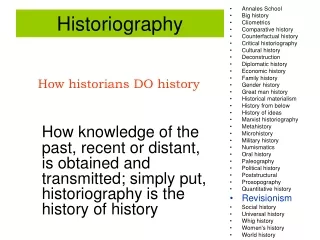
Other kinds of history • Historians write history through different lenses. Examples: • Annales: • History relying on insights from all areas of knowledge • Popular in France in the mid twentieth century
Feminist • Writing women back into history after centuries of their absences
Intellectual • The history of ideas
Social • The history of society
Military • History of wars, more or less
Legal • History of the law
And so forth… • Racial • Political • Quantiative • And the list goes on…