Jeopardy
561 likes | 675 Views
Dive into an exciting Jeopardy game focused on key concepts from the Enlightenment and Scientific Revolution. Choose a category and answer intriguing questions about renowned scientists and philosophers such as Galileo, Newton, Copernicus, and Rousseau. From the geocentric and heliocentric theories to natural rights and the social contract, challenge yourself and others with point values ranging from 10 to 50. Perfect for classrooms or trivia enthusiasts, this game will stimulate your mind and deepen your understanding of pivotal historical ideas.


Jeopardy
E N D
Presentation Transcript
Jeopardy Choose a category. You will be given the answer. You must give the correct question. Click to begin.
Choose a point value. Choose a point value. Click here for Final Jeopardy
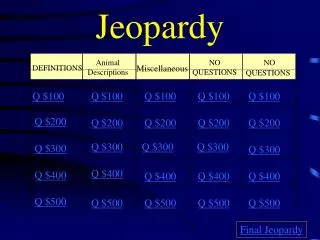
Science Scientist philosophies Philosophes Random 10 Point 10 Point 10 Point 10 Point 10 Point 20 Points 20 Points 20 Points 20 Points 20 Points 30 Points 30 Points 30 Points 30 Points 30 Points 40 Points 40 Points 40 Points 40 Points 40 Points 50 Points 50 Points 50 Points 50 Points 50 Points
According to Newton everything in the universe is what to every other object?
This theory states that the sun is at the center of the solar system
Kepler concluded that the planets move in what shape around the sun?
This person did not publish his findings until the last year of his life
This scientist thought of the universe as a clock and God as a clockmaker
What is that women need an education to become virtuous and useful?
Rousseau argued that the only good government is guided by this.
The idea of the rights of life, liberty, and property is featured in what historic U.S. document?
This person argued for the separation of powers of a government
This person wrote his philosophies in a book called Leviathan
This person is famous for saying “I do not agree with a word you say but I will defend to the death your right to say it.”
The new intellectual movement that stressed reason and thought and the power of individuals to solve problems.
This person was put under house arrest for their discoveries.
The new approach to science developed by Copernicus, Kepler, and Galileo.