Mutations
This overview explores the various types of mutations, including point mutations, frame shift mutations, and chromosome mutations. Point mutations involve nucleotide substitution that can lead to amino acid changes, while frame shifts result from insertions or deletions, significantly altering protein structure. Additionally, chromosome mutations, such as translocation, merge segments across nonhomologous chromosomes, affecting gene distribution. Mutations may arise from environmental agents known as mutagens, and distinctions are made between somatic and germ cell mutations regarding their potential to be inherited.
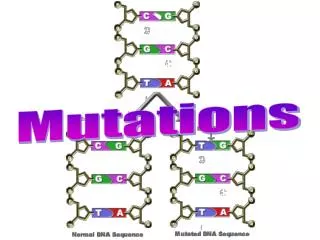

Mutations
E N D
Presentation Transcript
Defined: one nucleotide is substituted for another May be repaired by DNA polymerase May lead to amino acid change See animation May not lead to any change Ex: DNA “CCC” is mutated into “CCG” Same amino acid is created (glycine) Gene: Point Mutations T A C A G T G G T C A A A DNA U G U C A C A C A G U U U mRNA cysteine glutamine histidine glutamine phenylalanine Amino acids
Gene: Frame Shift Mutation C A C A G T G G T C A A A DNA • Defined: insertion/deletion of a nucleotide • Entire sequence of DNA/RNA after the mutation is shifted (see animation) • Much more serious to the structure/function of the final protein • mRNA sequence may have early or late “stop codons” G U G U C A C C A G U U U mRNA cysteine histidine glutamine phenylalanine Amino acids histidine serine leucine
Chromosome Mutations • Translocation: Chromosome segments combine with nonhomologous chromosome • Many genes wind up on entirely different chromosomes • Gene cut apart • ½ on chr #5, ½ on chr #8
Down’s Syndrome
Impact on Offspring • Somatic cell mutations • Affect only the individual • Not passed on to future generations • Ex: Muscle cell mutation • Germ cell mutations • May be passed to future generations • Ex: Sperm cell mutation
Mutation Causes • Mutagen: agents in the environment that can change DNA • Speed up replication process • Break apart nucleotides • Ex: UV sunlight breaks hydrogen bond between thymine (T) and adenine (A)