Mutations
Mutations are changes in the DNA nucleotide sequence that can occur in somatic cells or gametes. While most mutations are neutral and can be repaired by enzymes, some lead to conditions like skin cancers or genetic disorders, such as sickle cell disease. They are crucial for evolution, introducing variation that may benefit organisms. This overview explores the types of mutations, including chromosome mutations (deletion, inversion, translocation, nondisjunction, duplication) and gene mutations (substitution, insertion, deletion), shedding light on their implications.

Mutations
E N D
Presentation Transcript
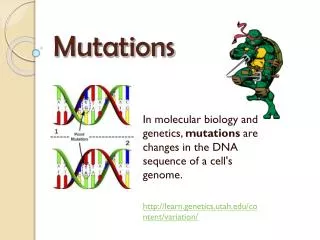
What Are Mutations? • Changes in the nucleotide sequence of DNA • May occur in somatic cells (aren’t passed to offspring) • May occur in gametes (eggs & sperm) and be passed to offspring
Are Mutations Helpful or Harmful? • Mutations happen regularly • Almost all mutations are neutral • Many mutations are repaired by enzymes
Are Mutations Helpful or Harmful? • Some type of skin cancers and leukemia result from somatic mutations • Genetic disorders like sickle cell result from mutations that affect all cells
Are mutations helpful or harmful? • Some mutations may improve an organism’s survival (beneficial)—the ultimate source of variation in the living world!
Chromosome Mutations • May Involve: • Changing the structure of a chromosome • The loss or gain of part of a chromosome
Chromosome Mutations • Five types exist: • Deletion • Inversion • Translocation • Nondisjunction • Duplication
Deletion • Due to breakage • A piece of a chromosome is lost
Inversion • Chromosome segment breaks off • Segment flips around backwards • Segment reattaches
Duplication • Occurs when a gene sequence is repeated
Translocation • Involves two chromosomes that aren’t homologous • Part of one chromosome is transferred to another chromosomes
Nondisjunction • Failure of chromosomes to separate during meiosis • Causes gamete to have too many or too few chromosomes
Gene Mutations • Change in the nucleotide sequence of a gene • May only involve a single nucleotide • May be due to copying errors, chemicals, viruses, etc.
Types of Gene Mutations • Include: • Substitutions • Insertions • Deletions
Substitution • Change of a single nucleotide • Often called a “point mutation” because it happens at a single point
Substitution • Sickle Cell disease is the result of one nucleotide substitution • Occurs in the hemoglobin gene
Substitution • Substitutions can also be silent mutations—meaning they have no effect on the protein
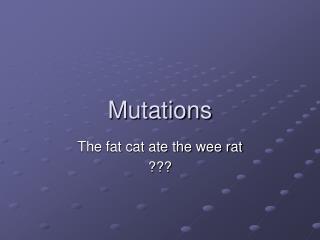
Frameshift Mutation • Inserting or deleting one or more nucleotides • Changes the “reading frame” like changing a sentence • Proteins built incorrectly
Frameshift Mutation • Original: • The fat cat ate the wee rat. • Frame Shift (“a” added): • The fat caa tet hew eer at.