Understanding the Vestibular System in Maintaining Balance and Gaze
240 likes | 425 Views
The vestibular system plays a vital role in maintaining balance, gaze, and posture through the inner ear, vision, and proprioception. Components such as the utricle and semicircular canals detect linear and rotational accelerations. Conflicting inputs to this system can lead to motion sickness. Learn about the intricate labyrinth of the vestibular apparatus and the central vestibular pathway’s function in stabilizing vision during head movements.


Understanding the Vestibular System in Maintaining Balance and Gaze
E N D
Presentation Transcript
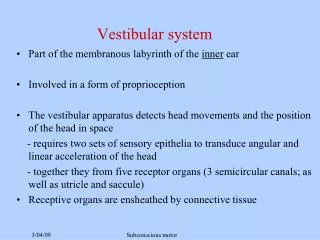
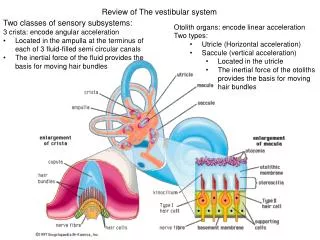
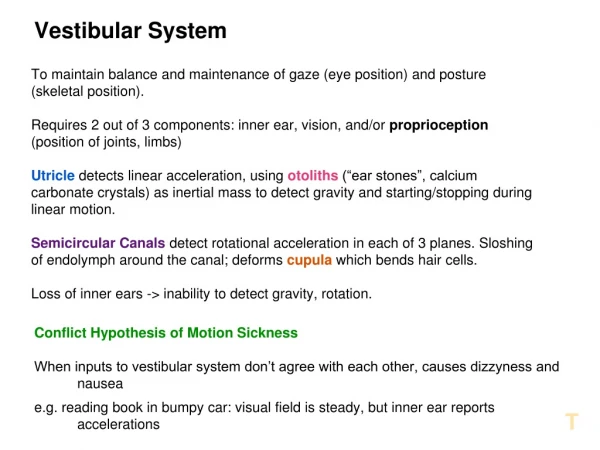
Vestibular System To maintain balance and maintenance of gaze (eye position) and posture (skeletal position). Requires 2 out of 3 components: inner ear, vision, and/or proprioception (position of joints, limbs) Utricle detects linear acceleration, using otoliths (“ear stones”, calcium carbonate crystals) as inertial mass to detect gravity and starting/stopping during linear motion. Semicircular Canals detect rotational acceleration in each of 3 planes. Sloshing of endolymph around the canal; deforms cupula which bends hair cells. Loss of inner ears -> inability to detect gravity, rotation. Conflict Hypothesis of Motion Sickness When inputs to vestibular system don’t agree with each other, causes dizzyness and nausea e.g. reading book in bumpy car: visual field is steady, but inner ear reports accelerations T
“bouncing, rocking” “not moving” Motion Sickness Fox Figure 10.17
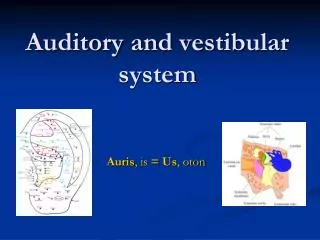
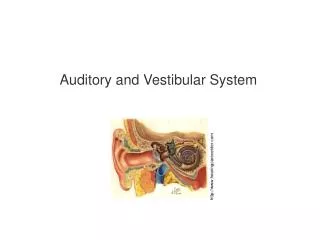
Vestibular Apparatus = “Labyrinth” Vestibulocochlear Cranial Nerve 8 Fox Figure 10.12
Utricle • detection of • linear acceleration
Gravitational force see Fox Figure 10.15
Semicircular Canals • detection of • rotational acceleration
Function: fixate line of sight on visual target during head movement Mechanism: senses rotations of head, commands compensatory movement of eyes in opposite direction Connections from semicircular canals, to vestibular nucleus, to cranial nerve nuclei excite extraocular muscles The Vestibulo-Ocular Reflex (VOR)