Parameter Estimation in RAMS Non-Hydrostatic KdVB Model for Arctic Boundary Layer Studies
This study presents an advanced parameter estimation approach using the RAMS non-hydrostatic model and the Korteweg-de Vries-Burgers (KdVB) model for analyzing complex atmospheric conditions in the Arctic. Conducted at the Sheba site on May 4, 1998, the experiments are optimized for both simple and complex models with a focus on data assimilation. The methodology improves the prediction accuracy of total humidity mixing ratios and enhances the identification of minimum and maximum centers. The research is pivotal for understanding Arctic boundary layer dynamics.

Parameter Estimation in RAMS Non-Hydrostatic KdVB Model for Arctic Boundary Layer Studies
E N D
Presentation Transcript
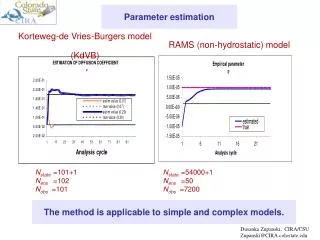
Parameter estimation RAMS (non-hydrostatic) model Korteweg-de Vries-Burgers model(KdVB) Nstate =101+1Nens =102Nobs =101 Nstate =54000+1Nens =50Nobs =7200 The method is applicable to simple and complex models. Dusanka Zupanski, CIRA/CSU Zupanski@CIRA.colostate.edu
RAMS/LES X= Z =50m,t=2s,Arctic Boundary Layer Cloud,Sheba site,May 4, 1998 MLEF experiments, G. Carrio et al. 2005
RAMS/LES X= Z =50m,t=2s,Arctic Boundary Layer Cloud,Sheba site,May 4, 1998 MLEF experiments, G. Carrio et al. 2005
ASSIMILATION Locations of min and max centers are much improved in the experiment with assimilation. DATA ASSIMILATION application: CSU-RAMS non-hydrostatic model: Total humidity mixing ratio (level=200m, Nens=50, Nstate=54000) TRUTH NO ASSIMILATION Dusanka Zupanski, CIRA/CSU Zupanski@CIRA.colostate.edu