Technical Overview of VUV/IR Ring Operation and Design Parameters (1992-2004)
200 likes | 313 Views
This document presents an intricate overview of the VUV/IR Ring's technical design and operational parameters at the National Synchrotron Light Source (NSLS) set from 1992 to 2004. Managed by Stephen Kramer, the VUV ring began operations in 1982, with X-ray capabilities in 1984, supporting over 2300 users annually. Key aspects include beam dynamics, thermal and microwave instabilities, and the development of far-infrared (FIR) ports and bolometers. Insights into the Collective Synchrotron Radiation (CSR), impedance measurements, and technical challenges faced in achieving stable emission highlight the ring's operational complexity.


Technical Overview of VUV/IR Ring Operation and Design Parameters (1992-2004)
E N D
Presentation Transcript
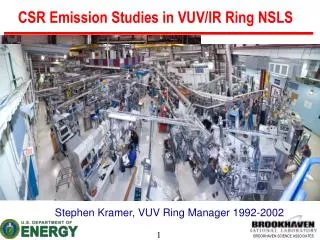
CSR Emission Studies in VUV/IR Ring NSLS Stephen Kramer, VUV Ring Manager 1992-2002
Technical Design Parameters NSLS VUV and Xray Light Sources Proposed in 1970’s VUV ops 1982, Xray ops 1984 with >2300 Users/year using >65 beam lines from Far-IR to Hard Xrays VUV /IR Ring Parameters
VUV Period for Achromatic Optics Peak x ~ 1.51 m,Doublet makes βx small in dispersion and large in ID making Touschek lifetime small due to septum edge
IR Developed in 1989 6 in 2004 e bolometer(lHe) UHV Source point Mirror M3 cone chop window MirrorsM1 and M2 lamellargratinginterferometer
FIR Port at end of Dipole U12IR extraction U11/U12/U12IR Two VUV ports ahead of FIR, at 7° and 22° into 45° dipole, ρ = 1.91 m dipole chamber shielding cut-off for CSR and ISR fc ~ 24 GHz or 0.8 cm-1
Threshold Current Microwave Instability Bunch length data showed a threshold of 100-120mA for Microwave threshold at 745-800 MeV with Zbb/n ~ 1.8Ω and Spear scaling
Energy Dependence Microwave Instability The microwave threshold based on the Keil-Schnell Criterion
FIR Measurements of Spectra in 2-FIR Interference model for line structure in both ISR and CSR pattern with Δf ~ 1cm-1 spacing in two similar beamlines with different spectra ranges
Reflection from Dipole Chamber Outer Wall Could give a Sin2(2π f Δt) modulation to broadband ISR and CSR spectra ΔL~1cm or frequency spacing ~ 30 GHz Slope =2*sin(/2) ~ 0.4 Zero at ~30 GHz due to 180 degree phase shift at metal boundary
FIR Beam Coupler Has Cut Off ~30GHz Optical coupling to FIR port cuts off below ~30 GHz, 4” beam window available 90° Metal paddle to block FIR beam deflects microwaves down to window (ring VC limits) Dipole chamber cut-off waveguide frequency TE1,0 ~ 2GHz and TM1,1 ~ 4 GHz Microwave measurements confirm CSR peak ~42GHz ~1.4 cm-1 peak “C”, but see two more “A and B” Microwave horns for deflected light
Time Dependence of Peak Signals • B and C are prompt signals from the bunch limited by RF diode ~1GHz BW Revolution time To=170nsec • A signal 60 -100ns wide delayed by ~30-50ns from bunch
Power in Peaks versus Bunch Current • C &B signal linear for Io < Ith • C&B quadratic for Io > Ith • C&B Ey polarization • A signal always quadratic or higher beam impedance P~ I2 * R • A signal unpolarized
A Peak - Wakefield Emission From Bellows Vacuum bellows shield with Cu convolutions 1cm gave calculated beam impedance RF microwave and charge modulation shows 6.5GHz but ~4GHz at current below Threshold current
Micro-bunching measured with SC Triggering the Streak Camera on the A peak signal yielded consistent micro-structure with 150 psec modulation or 6.5 GHz, no other micro-bunch was significant.
Warnock & Venturini CSR Signal + Interferr. Adding a 0.8cm delay for reflection from outer dipole chamber wall
Interference Pattern from Different Ports U10IR port has only 20° of bend ahead of port not > 23° for Interference pattern from dipole. However pattern from upstream dipole less clear.
Summary and Status • VUV ring CSR emission above Microwave Instability which scales with energy and α1 • CSR and ISR show interference pattern from outer wall broader than WG modes but related • Shielded ISR and CSR cut-off frequency appears to be ~ 24 GHz but sharp cutoff, allows the 6 GHz wakefield signal to be observed • Wakefield power growth proceeds CSR, shows clear micro-bunching above CSR threshold • FIR users not interested in stable CSR emission but maybe hard to achieve without RF upgrade