Integrating Sustainability in ICT Planning: A Thin Client Network for Small Schools
This document outlines strategies for integrating sustainability into ICT projects within small schools, emphasizing the use of a thin client network powered by Windows OS. It details energy-efficient architecture, renewable energy usage, and e-waste reduction. Key recommendations include the analysis of energy audit data, selecting energy-efficient hardware, and implementing power management software. By focusing on a pilot project model, the aim is to establish best practices for resource conservation and continuous improvement in alignment with industry benchmarks.

Integrating Sustainability in ICT Planning: A Thin Client Network for Small Schools
E N D
Presentation Transcript
Small School Thin Client Network Using Windows OS
Preparing to Integrate sustainability in ICT planning and design projects • develop and monitor policies for review and improvements, benchmarking against industry best practice and attempting new approaches continuously over time. • analyseenergy audit data on enterprise resource consumption • plan and integrate sustainability into ICT projects by devising strategies to conserve resources
ICT sustainability from a business standpoint • Selecting energy efficient architecture with longer life cycle. • Using renewable energy • Reducing e-waste • Pilot projects • How to produce an energy audit • Choosing energy efficient hardware • Using power management software
Energy efficiency as a stepping stone to sustainability • Choosing energy efficient hardware • Using power management software • Selecting energy efficient architecture – with longer life cycle, better utility • Using renewable energy • Reducing e-waste
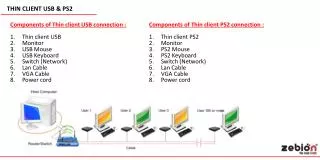
Individual Project Strategy • Thin client network for a small school • 1 server with Windows OS • 1 local printer • 1 router to connect to the Internet • 20 hp t410 AiO thin clients • 1 24 port switch with PoE
Network operation and security • Windows OS on server • Thin clients pxe into server • Anti Virus run on server • Thin clients need authentication to log in
Short term technology solutions to achieve reduction of power consumption • Using hp t410 AiO we can control the thin clients through the switch • Having the switch powered on from 7am to 5pm will reduce our power consumption
Recommendations and Conclusion. • Green ICTs are of global relevance. It is essential to limit the direct environmental impacts of ICTs in emerging economies • ICT applications can help limit accelerating energy use and material consumption in all countries. • Financing and local skills issues are likely to be key factors in successful strategies to diffuse and deploy smart ICT applications globally.