Understanding the Structure and Function of the Nucleus
This educational resource, prepared by Dr. R. Haritha, a lecturer in Biotechnology at Visakha Government Degree College for Women, outlines the nucleus's essential role and structure in eukaryotic cells. The nucleus, discovered by Robert Brown in 1831, serves as the repository of genetic information, governs cell growth and reproduction, and facilitates ribosome production through the nucleolus. With a double-layered nuclear envelope, the nucleus maintains stability and supports various cellular functions. Explore the intricacies of nuclear structure and its significance in cellular biology.

Understanding the Structure and Function of the Nucleus
E N D
Presentation Transcript
NUCLEUS- STRUCTURE & FUNCTION Dr. R. Haritha Lecturer in Biotechnology Visakha Government Degree College for Women Visakhapatnam
Contents • Definition of Nucleus • Primary Functions • Structure of Nucleus • What have we learnt?
Nucleus The nucleus is a membrane bound structure that contains the cell's hereditary information and controls the cell's growth and reproduction.
Discovered by an English biologist Robert Brown in 1831. • Important part of the cell. • Spherical or oval structure. • Located in the Centre of the cell.
Primary Functions • Repository of genetic information • Enables synthesis of nearly all proteins • Houses the nucleolus • Responsible for production of ribosomes. • Selective transportation of regulatory factors and energy.
Structure of the nucleus Average diameter of nucleus is 6 um, which occupies around 10% of cell volume. • Nuclear Envelope • Nuclear Membrane • Nucleolus • Nucleoplasm • Chromosomes
Nuclear envelope • Double-layered membrane enclosing the nucleus of a eukaryotic cell. • Also called nuclear membrane.
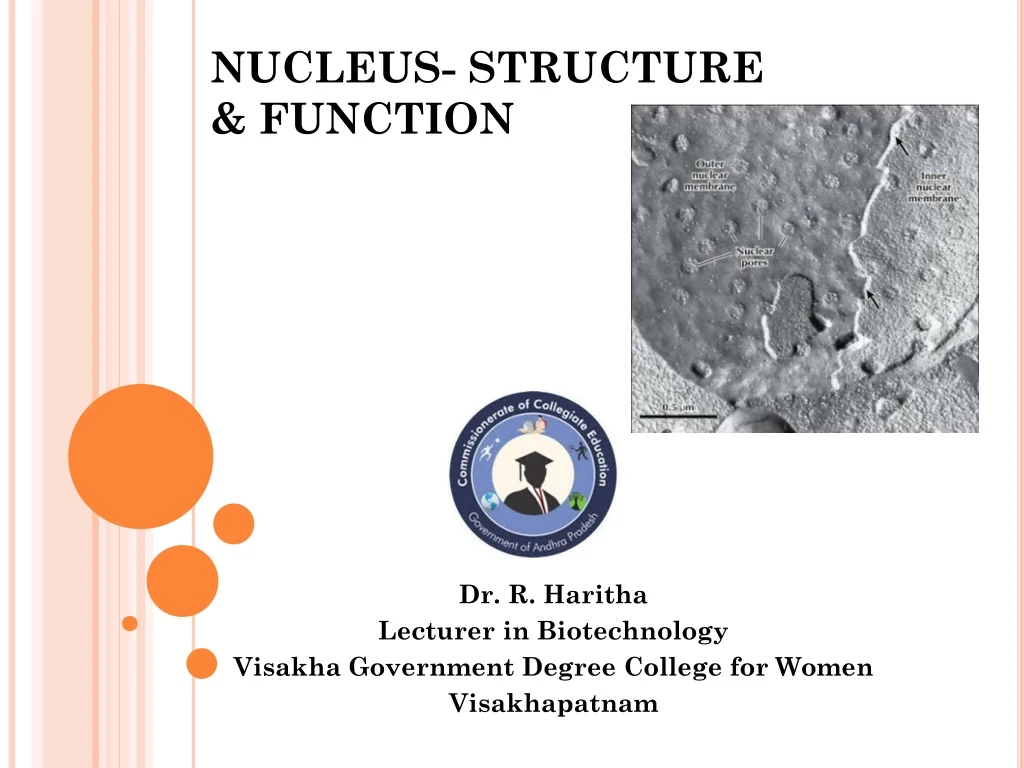
Nuclear Membrane • Nucleolemma or karyotheca • Phospho lipid bilayer membrane • Consists of two lipid bilayers— • 1. the inner nuclear membrane • 2. the outer nuclear membrane.
Nuclear Pore • composed of multiple proteins • allows the passage of molecules from inappropriate entering or exiting the nucleus.
NUCLEAR LAMINA • structural support for the nuclear envelope • anchoring sites for chromosomes and nuclear pores.
Progeria Defective Lamina protein makes the nucleus unstable. That nuclear instability appears to lead to the process of premature aging in Progeria.
Nucleolus • 25% of the volume of the nucleus. • Proteins and ribonucleic acids (RNA). • Site of transcription • Assembly of ribosomes
Nucleoplasm • Also known as karyoplasm. • Made up mostly of water, a mixture of various molecules, and dissolved ions. • Act as a suspension for organelles • Maintains the shape of the nucleus.
Chromatin • Long thin stands of DNA. • Contains instructions that control cell metabolism and heredity.
Which of the following parts of nucleus is responsible for the assembly of ribosomes? A • Nuclear • Pore C • chromosomes • Nucleolus D • Chromosomes B • Nuclear membrane
The genetic material complexes with proteins and is organized into linear structures called: A • nucleolus C • chromosomes • chromosomes D • plasmids B • histones
Provide structural support for the nuclear envelope and anchoring sites for chromosomes and nuclear pores. A • Nucleoplasm C • Nuclear Lamina • Nuclear Lamina B • Nucleolus D • Nuclear Membrane
The space between the two nuclear membranes is called: perinuclear space C A perinuclear space • nuclear space • internuclear space B D none of these
It prevents larger molecules, such as nucleic acids and larger proteins, from inappropriately entering or exiting the nucleus. C A nuleolus • nuclear lamina • nuclear envelope nuclear pores B D nuclear pores