Engineering Exploration
This educational exploration delves into the Mountain Pine Beetle (Dendroctonus ponderosae), a significant pest affecting Colorado's pine forests. Students will learn how abiotic factors influence population sizes and understand that climate results from the energy transfer among the atmosphere, hydrosphere, geosphere, and biosphere. The course examines the beetle's relationship with fungi, its impact on tree health, and the devastating effects it has on various pine species, resulting in the loss of millions of trees.

Engineering Exploration
E N D
Presentation Transcript
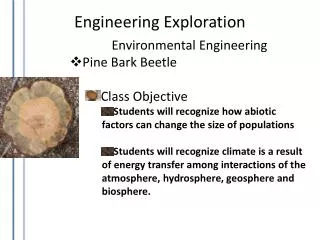
Environmental Engineering • Pine Bark Beetle • Class Objective • Students will recognize how abiotic factors can change the size of populations • Students will recognize climate is a result of energy transfer among interactions of the atmosphere, hydrosphere, geosphere and biosphere. Engineering Exploration
Environmental Engineering • Pine Bark Beetle • What is the Mt. Pine beetle? • The mountain pine beetle (MPB) scientific name is Dendroctonusponderosae. • The (MPB) is native to the forest of western • North America • Also known as Black Hills beetle Engineering Exploration
Environmental Engineering • Pine Bark Beetle • Why is the Mt. Pine bark beetle important? • Its said that Mt. Pine Beetles (MPB) are one of the most important insect (pest) of Colorado's pine forests. • Pine beetle can result in losses of millions of trees. They may be found in ponderosa, lodge pole, scotch, and limber pine. Engineering Exploration
Environmental Engineering • Pine Bark Beetle • What is the relationship between the beetle and the fungus? • Fungus • Phloem of a tree • Blue stain • “Beetle kill” tree Engineering Exploration
Environmental Engineering • Pine Bark Beetle • What is the size of the beetle? • The MPB is between 1/8 inch to 1/3 inch in size. It’s about the size of a grain of rice. Engineering Exploration