Download

1 / 19
190 likes | 325 Views
This paper explores the dynamics of Hurricane Charley (August 2004), focusing on the concept of trough interaction and its effects on hurricane intensity. Key discussions include the EFC (Eddy Flux Convergence) theory, potential vorticity, and how upper-level troughs influence hurricane behavior. We analyze models that predict intensification, noting the complex interplay of dynamics and thermodynamics. The paper concludes with the necessity for better data and modeling techniques to accurately forecast hurricane interactions with troughs, emphasizing the need for further research in this area.

E N D
Hurricane CharleyAug. 2004 Rapid Intensification and Trough Interaction By: Andy Latto
Objectives • What is trough interaction? • EFC Theory (Eddy Flux Convergence) • Potential Vorticity – PV • Model’s incorporating and forecasting trough interaction.
Trough Interaction • Dynamical and thermodynamic interaction between a hurricane vortex and upper level trough. • Trough needs to be close but not too close to storm for positive interaction (< 400 to 1000km) • Trough acts as a catalyst and storm responds positively or negatively.
Trough Interaction Theories • EFC – • PV 2 – Added heating (omega) aloft forces a stronger thermal gradient below. • Enhanced outflow due to increase in upper level flow. • Potential Vorticity: According to QG Theory, added positive vorticity advection increasing with height causes low level ascent.
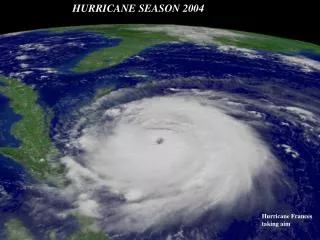
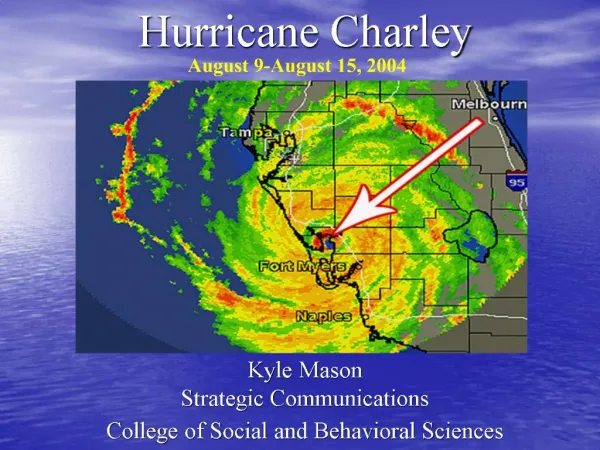
Hurricane Charley August 2004
Hurricane Charley • Rapid Intensification: -24 hPa in 6 hours
Models Used GFDL AVN Global Model 100KM resolution Good for synoptic scale flows Bad for hurricane intensity • Uses Axi-symmetic vortex • Adds in asymmetric vortex • Triple-nested movable mesh • 1/12 degree resolution • Good for hurricane intensity • Problems with initialization
Results / Conclusion • EFC and PV during trough interaction can either strengthen or weaken a TC • Excess vertical shear caused by either PV of EFC is negative factor for intensification. (Balance is important) • Rapid intensification of TC’s is believed to need trough interaction, in part to occur. • Better data analysis, more offshore vertical data, and incorporation of data/equations into models necessary for accurate forecasting of trough interactions. • Lots theories at work here, and more work needs to be done to confirm these ideas.
ANY • QUESTIONS???????????????????????????????????????????? • References are in typed paper