Download
1 / 13
130 likes | 270 Views
This Earth Science review explores key concepts such as erosion, the smoothing of river rocks, soil's water retention capabilities, and methods used by meteorologists to forecast weather. It delves into the differences between high and low pressure systems, the significance of weather fronts, and how these factors contribute to weather patterns. Through engaging activities and explanations, the review provides a comprehensive overview for students eager to learn about Earth's processes and the science behind weather prediction.

E N D
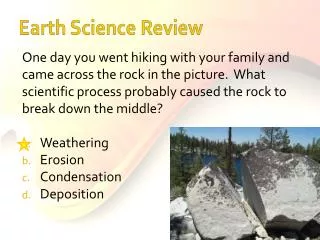
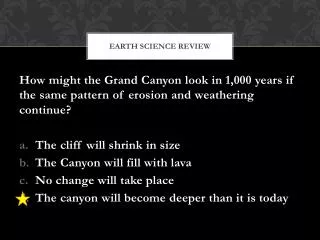
Earth Science Review The wearing away and movement of sediment by wind, water, or ice is called_______________ Erosion Weathering Deposition Sediment
Earth Science Review Why are “river rocks” usually smoother than other rocks? River rocks are made of a different material than other rocks River rocks have been weathered by wind which makes them smother River rocks have a smaller mass than regular rocks River rocks have been weathered by water which makes them smoother.
Earth Science Review What is the best way to test a soil’s ability to hold water? Mix water with a pile of soil and see if the water changes temperature Pour soil into a bowl of water, stir it up, and see if it disappears Pour water through a funnel of soil and see how much water drips out into a cup Add soil to a beaker full of water and see if the soil sinks
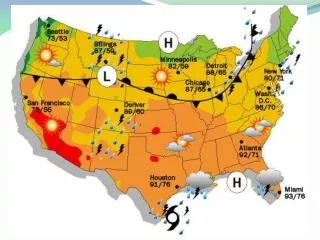
Weather forecasting is a prediction of what the weather will be like in an hour, tomorrow, or next week. Weather forecasting involves a combination of computer models, observations, and a knowledge of trends and patterns. By using these methods, reasonable accurate forecasts can be made up to seven days in advance. How do meteorologists forecast the weather?
A high pressure system is a whirling mass of cool, dry air that generally brings fair weather and light winds. When viewed from above, winds spiral out of a high-pressure center in a clockwise rotation in the Northern Hemisphere. These bring sunny skies. A high pressure system is represented as a big, blue H. What is a High Pressure System? H
A low pressure system is a whirling mass of warm, moist air that generally brings stormy weather with strong winds. When viewed from above, winds spiral into a low-pressure center in a counterclockwise rotation in the Northern Hemisphere. A low pressure system is represented as a big, red L. What is a Low Pressure System? L
A front is a boundary between two different air masses, resulting in stormy weather. A front usually is a line of separation between warm and cold air masses. What is a front?
A cold front is a boundary between two air masses, one cold and the other warm, moving so that the colder air replaces the warmer air. A cold front is represented as a blue line with the teeth pointing toward the direction on movement. What is a cold front?
A warm front is a boundary between two air masses, one cool and the other warm, moving so that the warmer air replaces the cooler air. A warm front is represented as a red line with half circles pointing toward the direction on movement. What is a warm front?
A stationary front is a boundary between two air masses that more or less doesn’t move, but some stationary fronts can wobble back and forth for several hundred miles a day. A stationary front is represented as an alternating warm and cold front symbol. What is a stationary front?
???? How do meteorologists forecast the weather?
Lets have some fun predicting the weather and learning how to read a weather map. • http://www.edheads.org/activities/weather/frame_loader.htm • Main web page to Ed: http://www.edheads.org/activities/weather/index.shtml Map Reading Practice