Download
1 / 25
250 likes | 373 Views
This lesson explores the lithosphere, including its components, and the various types of plate boundaries: convergent, divergent, and transform. Students will learn how each boundary affects the Earth's structure and movement. Additionally, the lesson covers the behavior of animals, like dogs, before earthquakes and introduces key concepts in measuring earthquakes, including types of seismic waves (P waves, S waves, and surface waves), seismographs, and scales of measurement (Richter, Moment Magnitude, and Modified Mercalli). Finally, the challenges of predicting earthquakes will be discussed.

E N D
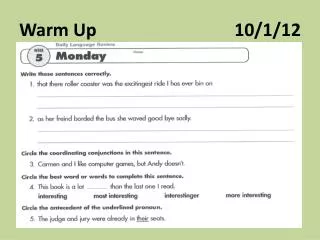
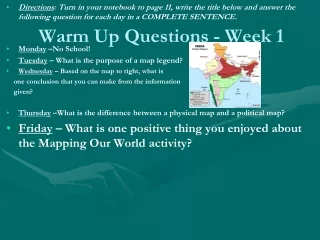
Warm-up Week 12 Day 1 • The Lithosphere includes Earth’s C_______ and part of the M_________. • What are the three types of plate boundaries called? • Describe what happens at each type of plate boundary. • How can dogs tell that a major earthquake is about to happen? (What might they feel?)
“Measuring Earthquakes” Chapter 8, Section 2
Earthquake Waves • “Seismic” = … • Surface waves travel along the ground and cause the ground and anything resting upon it to move • Gases and liquids do not transmit s waves, but do transmit p waves • A seismogram shows all three types of waves: the p waves arrive first, then the s waves, followed by the surface waves last • The waves arrive at different times because they travel at different speeds
Surface Waves • Wavesthat travelalong Earth’s surface • Most destructive!
P Waves • “Push-Pull waves” • Compressrocks • Expand rocks • FASTEST waves!
S Waves • Shaketheparticlesatright angles • Cannotmove throughwaterorair.
Seismograph Toolthat recordsearthquakewaves
“Seismos” = Shake “Gramma” = What is written Seismogram A drawingfrom aseismograph
Travel-Time Graph • Used to finddistancetoepicenter
Finding an Epicenter. • Triangulation • Technique used to find location of epicenter • “Three Circles”
Measuring Earthquakes • Intensity • Estimate of damage to an area. • Magnitude • Size of seismic wave
3 Scales of Measurement • Richter Scale • Outdated • Measures amplitude of the largest seismic wave (1-10). • Moment Magnitude Scale • Widely used • Movement at fault • Measures energy released • Modified Mercalli Scale • Measures “Destruction” • 12 steps ( I—XII ) • 1 = Gentle, 12 = Bad!
Q: What affects the amount of Destruction? • How bigthe seismic waves are. • Howlong it lasts. • Compositionof ground. • Designof buildings.
Hazard - Liquefaction Niigata, Japan 1964
Hazard – Ground Shaking Northridge, CA 1994 Loma Prieta, CA 1989
Hazard – Surface Faulting Landers, CA 1992
Hazard - Landslides Turnnagin Heights,Alaska,1964
Hazard – Fires Loma Prieta, CA 1989
Predicting Earthquakes? • Goal: • EARLY WARNING. • Success? • NO. • Seismic gap • Place along a fault that is “overdo.”