Download
1 / 13
130 likes | 266 Views
This overview delves into the scientific method as it applies to economics, contrasting positive and normative economics. Positive economics deals with factual statements and logical deductions, while normative economics expresses value judgments about what ought to be. We will explore necessary and sufficient conditions for causality, highlighting the importance of systematic observation, measurement, and theory testing. Additionally, we examine common fallacies in logic and their implications for economic theories, using examples from real-world scenarios, such as the impact of weather on sports and the principles of competitive balance in the NFL. ###

E N D
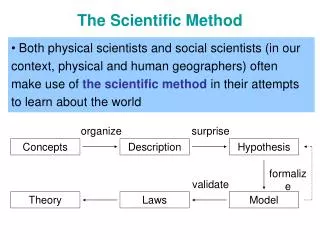
The Scientific Method • Positive Vs. Normative Economics • The Scientific Method • Necessary & Sufficient Conditions • Testing Causality • Fallacious Arguments • Testing Theory
Positive Vs. Normative Economics • Positive Economics Statements of fact & logical deductions Ex: If it rains the football field will get wet. • Normative Economics Statements about what should be (value judgments) Example: The football field is better when it is wet.
Carefully study it. Systematic Observation & Measurement Observe a Phenomenon The Scientific Method Develop a theory to explain the data Confirm / Re-examine Not Prove or Disprove Check the implications of your theory against new data from similar circumstances
Necessary & Sufficient Conditions • A is said to be a sufficient condition for B. If A happens B will be guaranteed to occur. • EX: Ceteris Paribus, if it rains then the football field will be wet. Necessary & Sufficient Conditions.
Testing Causality • If A is observed and ceteris paribus B does not occur then the idea that A causes B is called into question. • EX: Theory: C.P. Price is negatively related to quantity demanded. • We observe price falling and ceteris paribus quantity demanded also falls. Does the data support the theory?
Testing Causality • Econometrically we can estimate an equation for demand. • Q = f(Price, Income, Other Variables) • What is the predicted sign on the coefficient of price? (Is it significant?)
Fallacies • Denying the antecedent: It did not rain therefore the football field cannot be wet (How about a sprinkler system?) • Affirming the consequent: The field is wet therefore it must have rained. (Sprinklers may have been on)
Contrapositive • The only logical equivalent to A=> B is the contrapositive statement ~B => ~A. • EX1: If it rains then the field will be wet. (Contrapositive) The field is dry therefore it did not rain. • EX2: If cigarettes are addictive then past consumption influences present consumption. (Contrapositive) If past consumption does not influence present consumption then cigarettes are not addictive.
Competitive Balance in the NFL • Measuring Competition: HHI = (MSi)2 • MSi = Market Share for a Team = (Wins for that team / # of League Games)
Factors Affecting Competition • HHI = f (FA/SAL, EXPAN, EXPAN(1) STRIKE, PLAYER TALENT, HHI(-1)) • FA/SAL = Free Agency/ Salary Cap Year 1993 • EXPAN= Expansion Year • EXPAN (1) = Year after expansion • STRIKE = Strike Year • Player Talent Concentration
PLAYER TALENT = HHIPF + HHIPA • HHIPF = (Points Scoredi / Total Points Scored in the League)2 • HHIPA = (Points Scored Againsti / Total Points Scored Against in the League)2