Understanding Light as Electromagnetic Waves: Key Concepts and Applications
In this lecture, we explore light as an electromagnetic (EM) wave, discussing its properties and behavior. Key topics include the oscillating electric and magnetic fields of EM waves, the speed of light in a vacuum, and how energy is transferred without a material medium. The electromagnetic spectrum is examined, from radio waves to gamma rays, highlighting their unique characteristics and applications. Additionally, we explore concepts of intensity, radiation pressure, and color vision, detailing how our eyes perceive different wavelengths and mixtures of light.

Understanding Light as Electromagnetic Waves: Key Concepts and Applications
E N D
Presentation Transcript
Light Physics 202 Professor Vogel (Professor Carkner’s & CJV notes, ed) Lecture 10
Light • Electromagnetic wave • oscillating electric and magnetic fields – • no material medium that is moving! • energy transfer at speed v (c=3X10⁸ m/s in vacuum) • wavelength = distance between repeats • frequency = # repeats per second l f fl=v v=c in vacuum c=3X10⁸ m/s
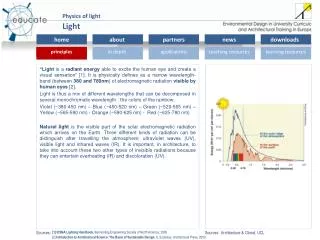
Radio > 1 meter penetrates solid objects easily Millimeter (microwave) 1 m - 1 mm used for communication Infrared 1 mm - 700 nm we feel as heat Visible 700-400 nm eyes evolved to see Ultraviolet 400 nm - 100 A higher energy, causes sunburn X-ray 100 A - 0.01 A penetrates soft things but not hard Gamma Ray < 0.01 A hard to produce and dangerous The EM Spectrum
The EM Wave • Lets consider light as a wave • What kind of wave is it? • What is oscillating? • An EM wave consists of an electric field wave (E) and a magnetic field wave (B) traveling together • The 2 fields are perpendicular to each other and to the direction of travel • An EM wave is transverse (like string waves) • The field waves are sinusoidal and in phase
Wave Equations • We can generalize the waves as: E = Em sin (kx -wt) B = Bm sin (kx -wt) • Nothing is actually moving • There is no string • A changing E field induces a B field • A changing B field induces an E field • The two fields continuously create each other • The speed of the wave is related to the fields: c = E/B
Key Constants • Two important constants in E and M are the permittivity constant e0 and the permeability constant m0 • Permittivity is the electric force constant: e0 = 8.85 X 10⁻¹² F/m • In farads per meter • Measure of how electric fields propagate through space • Permeability is the magnetic force constant: m0 = 1.26 X 10⁻⁶ H/m • In henrys per meter • Measure of how magnetic fields propagate through space • The wave speed depends on these constants: c = 1/(m0 e0)½
Poynting Vector • EM waves transport energy • The amount of energy delivered per unit area per unit time is given as flux: flux = W/m2 = J/s/m2 • Flux for an EM wave can be given by the Poynting vector: S = (1/m0) EB • However, E and B are related by E/B = c so we can rewrite S as: S = (1/c m0) E2
Intensity • The value of S depends on where the EM wave is in its cycle • We generally are interested in the time averaged value of S, known as the intensity I = (1/c m0) Erms2 • Where Erms is the root-mean-square value of the electric field
Radiation Pressure • EM waves exert a pressure on objects • If someone shines a flashlight on you, the light is trying to push you away • like ball bouncing off object pushes object back • The force is very small in most cases • EM pressure is due to the fact that light has momentum which can be transmitted to an object through absorption or reflection
Momentum Transfer • The change in momentum due to light is given by: Dp = DU/c • Where Dp is the momentum change and DU is the energy change • The above equation is for absorption • For reflection the momentum change is twice as much: Dp = 2DU/c
Light Pressure • From Newton’s second law F = Dp/Dt • The amount of energy delivered in time Dt is: DU = I A Dt • where I is the intensity and A is the area • Since pressure (pr) is force per unit area the pressure becomes: pr = I/c (total absorption) pr = 2I /c (total reflection)
Color Vision • Rods and cones • one type of cone responds to long l’s: “R” • one type of cone responds to mid wavelengths: “G” • one type of cone responds to short l’s: “B” • How our eyes view pure waves: • red : R-type responds • green : G-type responds • blue : B-type responds • yellow : R- and G-types respond • Cyan: G- and B-types respond
Color Addition • How our eyes view mixtures : • blue + red: R- and B-types respond • magenta • green + blue : G- and B-types respond • indistinguishable from cyan • red + green : R- and G-types respond • indistinguishable from yellow (Like no pure color) • Demo of color addition -- HELP
Color Addition • How our eyes view mixtures : • red + green : R- and G-types respond • indistinguishable from yellow • red + green + blue : R-, G-, and B-types respond • white • yellow + blue : R-, G-, and B-types respond • white
Color Subtraction • How our eyes view pigments (absorb light) • white - blue: R- and G-types respond • pigment that absorbs blue looks yellow • white - red : G- and B-types respond • pigment that absorbs red looks cyan • white - (blue + red): G-type responds • pigment that absorbs blue and red looks green
Color Subtraction • How our eyes view pigments: • white - (blue + red): • pigment that absorbs blue and red looks green • Pigment: yellow + cyan: • pigments that absorb blue and red look green • A demo of subtraction • usflag-neg.gif
primary color red green blue Complementary color cyan magenta yellow Complementary color= white - color