
Complex Numbers
E N D
Presentation Transcript
Complex Numbers Section 3.2 Beginning on page 104
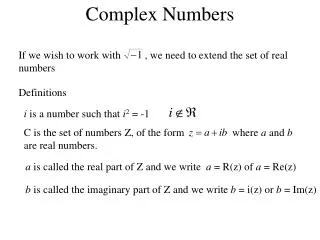
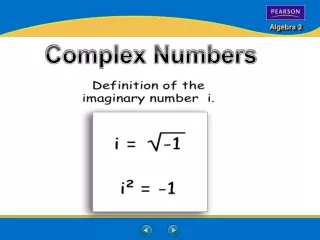
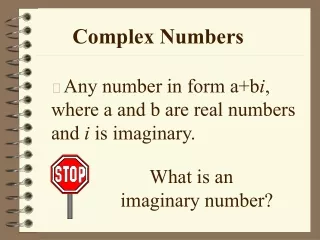
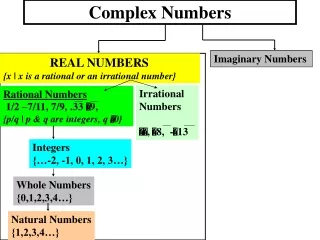
Imaginary Numbers and Complex Numbers Imaginary numbers allow us to simplify radicals with no real solutions. A complex number written in standard form is a number where and are real numbers. The number is the real part, and the number is the imaginary part. Real Numbers: Complex Numbers: Pure Imaginary Numbers:
Examples 1 and 2 Example 1: Find the square root of each number a) b) c) Example 2: Find the values of x and y that satisfy the equation ** Set the real parts equal to each other, set the imaginary parts equal to each other. Solve the resulting equations. **
The Sums and Differences of Complex Numbers To add (or subtract) two complex numbers, add (or subtract) their real parts and their imaginary parts separately. Example 3:
Multiplying Complex Numbers Example 5: Multiply. Write the answer in standard form. a) b) ** **
Solving Quadratic Equations Example 6: Solve a) b) 18
Finding Zeros of Quadratic Functions Example 7: Find the zeros of The zeros of the function are and
Practice Find the square root of the number. 2) 3) 4) Find the values of x and y that satisfy the equation. 5) 6) Perform the operation. Write the answer in standard form. 8) 9) 10) 11) 12) 13) Answers: 1) 2) 3) 4) 5) 6) 8) 9) 10) 11) 12) 13)