
Model Checking for CTL and CTL*: Algorithms, Modalities, and Semantics Explained
E N D
Presentation Transcript
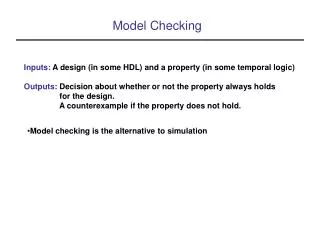
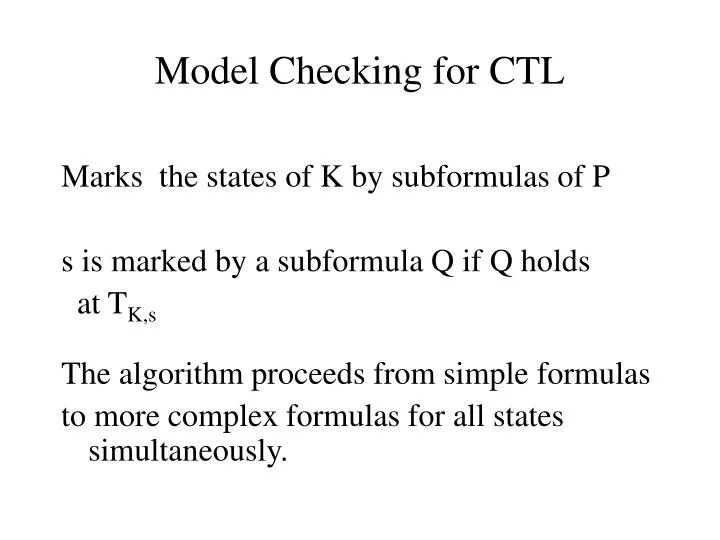
Model Checking for CTL Marks the states of K by subformulas of P s is marked by a subformula Q if Q holds at TK,s The algorithm proceeds from simple formulas to more complex formulas for all states simultaneously.
Algorithm For atomic formulas – immediately For Boolean connectives – easy s is marked by P1& P2 if …. For modal connectives: P1 U P2 : if from s there is a P1 path to a P2 node. For modal connectives: P1 U P2 ……
CTL* Modalities: E( a formula of TL(U)) A ( a formula of TL(U)) Semantics: T,s|= E C if there is a path from s which has a property C.
Model Checking for CTL* How to check E (‘ property of a path’) Construct an automaton A for the property. Take the product with the Kripke Structure.
Equation for P1 U P2 X - the set that satisfy P1 U P2 X= P2 (X& P1 ) X=H(X) where H = λ Y. P2 (Y & P1 ) How many solution Z=H(Z) has?
Characterization of P1 U P2 P1 U P2 is the minimal solution of Z= P2 (Z & P1 ) X0= P2 Xn+1= P2 (Xn & P1 ) s in Xn iff there is a P1 path of length≤ n+1 from s to P2 X= Xn X=H(X) and H monotonic
Mu-calculus E := At| ¬ At| X| E1 &E2| E1E2| E | A E|μ X. E| νX.E Semantics: μ least fixed point; ν greatest fixed point. [| E |]ρ the set of states that satisfies E in the enviroment ρ: Var-> States.
EGp EGp = νX.p& X
From mu-calculus to MLO Theorem: for every mu-formula c(X1,…,Xn) there is an MLO formula b(t, X1,…Xn) which is equivalent to c over trees. Theorem: for every future MLO formula b(t,X1,…Xn) which is invariant under counting there is anequivalent (over trees) mu formula c.
Symbolic Model Checking Explicit Model Checking: Input a finite state K and a formula c Task Find the states of K that satisfy c. Symbolic model checking Input a description of K and a formula c Task Find a description of the states of K that satisfy c.
A description of Kripke structures by formulas • s(x1,…,xn) describes a set of states • t(x1,…xn,x1’,…xn’) describes transitions • For every label p a formula lp(x1,…xn) that describes the states labeled by p.
BDT, and OBDD • Binary decision trees • Ordered Binary Decision Diagrams.