Download
1 / 1
10 likes | 138 Views
We aim to develop an Asymmetric Halogen-Metal Exchange (AHME) process using a recyclable planar chiral iodoferrocene reagent to synthesize valuable scalemic carbenoid reagents and facilitate the kinetic resolution of geminal chloroiodides. Our research confirms the viability of each component of the AHME cycle, which includes the optimal synthesis of silyl and alkyl substituted dihalides, along with the efficient utilization of lithium-iodine exchange with standard alkyl lithium reagents, generating highly diastereoselective epoxysilanes.

E N D
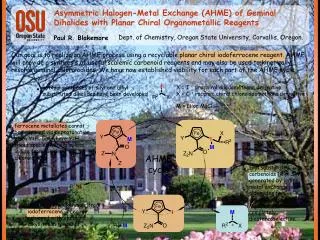
Asymmetric Halogen-Metal Exchange (AHME) of Geminal Dihalides with Planar Chiral Organometallic Reagents Paul R. Blakemore Dept. of Chemistry, Oregon State University, Corvallis, Oregon. Our goal is to realize an AHME process using a recyclable planar chiral iodoferrocene reagent. AHME will provide a synthesis of useful scalemic carbenoid reagents and may also be used to kinetically resolve geminal chloroiodides. We have now established viability for each part of the AHME cycle. • X = I X = Cl prochiral diiodomethane derivative racemic chiral chloroiodomethane derivative optimal syntheses of silyl and alkyl substituted dihalides have been developed M = Li or MgCl • ferrocene metallates cannot be prepared via deprotonation when Y≠H; but where Y=H, these species will assimilate iodide from diiodides or chloroiodides AHME cycle • silyl substituted carbenoids (R2 = SiMe3) generated by iodine-metal exchange add to aldehydes to give epoxysilanes. With M = MgCl the reaction is completely diastereoselective. • lithium-iodine exchange from iodoferrocene is readily achieved with standard alkyllithium reagents