When Worlds Really Did Collide
30 likes | 154 Views
This article explores the fascinating world of iron meteorites, particularly focusing on the cooling rates of group IVA irons, the fourth largest meteorite group. It highlights the factors influencing cooling rates, which can vary over a factor of nearly 100, suggesting the presence of a metallic core with minimal rocky insulation. Additionally, the study discusses the role of planetary collisions and molten planetesimals in forming significant bodies of molten metal, shedding light on the processes of planetary accretion.


When Worlds Really Did Collide
E N D
Presentation Transcript
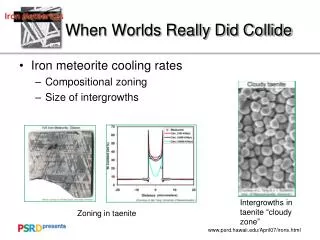
When Worlds Really Did Collide • Iron meteorite cooling rates • Compositional zoning • Size of intergrowths Intergrowths in taenite “cloudy zone” Zoning in taenite www.psrd.hawaii.edu/April07/irons.html
When Worlds Really Did Collide • Cooling rates of group IVA irons (fourth largest group) range over a factor of almost 100 • Implies cooling of a metallic core with little or no rocky insulation • How do we produce a huge (300 km) blob of molten metal? www.psrd.hawaii.edu/April07/irons.html
When Worlds Really Did Collide • Collisions of molten planetesimals may be the answer • Consistent with dynamical models of planetary accretion www.psrd.hawaii.edu/April07/irons.html