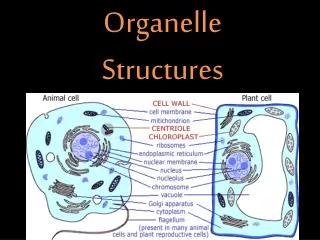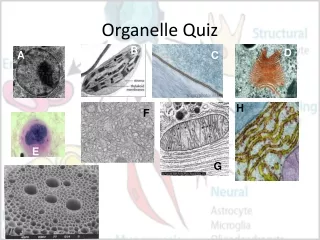
Organelle Structures
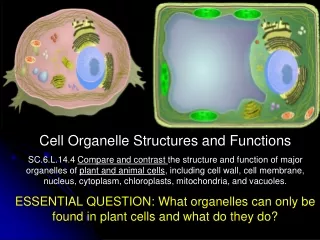
This informative piece delves into the various organelles that make up plant and animal cells. It highlights the vital functions of mitochondria, chloroplasts, and the nucleus, which are central to energy production and genetic material management. The text explains how ribosomes, endoplasmic reticulum, Golgi body, vesicles, vacuoles, lysosomes, peroxisomes, and centrioles contribute to cellular operations, emphasizing their roles in protein synthesis, material transport, and cell division. A comprehensive overview for anyone interested in cellular biology!

Organelle Structures
E N D
Presentation Transcript
Organelle Structures Thanks to: Danielle, Madison + Alexa
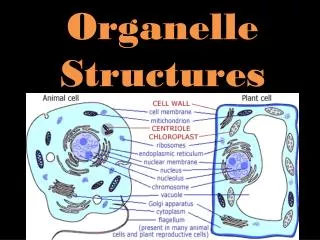
Responsible for cell respiration • Produces energy from sugar • Powerhouse of the cell • The more energy required, the more of these areneeded • Plants and Animals
Responsible for photosynthesis which produces sugars and gives plant energy • This is transferred to the mitochondria • Plant
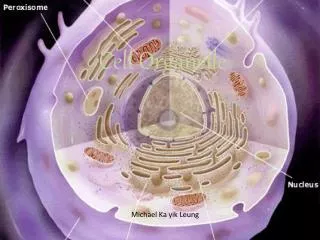
Brain of the cell • Controls all cell functions • Stores DNA • Plants and Animals
Found in the nucleus • 3 to 5 of them found in 1 nucleus • Makes ribosomes • Plants and Animals
Membrane that surrounds the nucleus- helps to give nucleus form and structure • Protects and houses DNA and nucleolus • Plants and Animals
Gives plant cells structure • Outermost part of plant cell • Made of cellulose (complex sugar) • Not selectively permeable • Plant
Outer layer in animal cells • Lines the inside of the cell wall in plants • Selectively permeable • Protects • Has proteins embedded in it • Plants and Animals
Makes proteins • Found in the cytoplasm and on the rough endoplasmic reticulum • Plants and Animals
Dotted with ribosomes • Transport mechanism to move materials around the cell • Proteins are modified and manufactured in here • Plants and Animals • “highway” of the cell
Has no ribosomes • Transport tunnel- like mechanism move materials around the cell (just like the Rough ER) • Transports lipids and carbs • Plants and Animals • “highway” of the cell
Transports materials both in and out of the cell • Found at the end of the ER • The “mailroom” of the cell – makes deliveries – picks up products and packages them into a membrane bound vesicle to be delivered • Plants and Animals
Little membrane bound “packages” that carries material the cell needs • Fuses with the cell membrane when materials leave the cell (joins the outer membrane)- cell becomes bigger – it also works in reverse – takes in material into the cell (amino acids) and a part of the outer membrane help Plato form the vesicle’s membrane • Plants and Animals
Membrane bound sac that is larger in plants (1), smaller in animals (several) that contains water • Stores food and water because it doesn’t make food • Plants and Animals
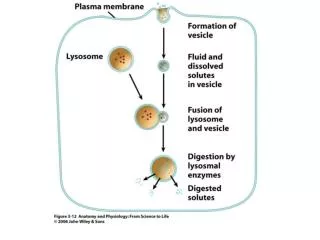
Contain digestive enzymes • Break down and recycle macromolecules like protein and carbs • Also breaks down and recycles organelles • Like a “vacuum” cleaner of the cell • Plants and Animals
Produce an enzyme called catalase – converts hydrogen peroxide into water and oxygen • Used as a defensive mechanism to neutralized dangerous materials • Plants and Animals
Involved with cell division • Part of the cytoskeleton • Spindle fibers grow out of the centrioles • Animals
Liquid/ gel-like portion of the cell • Supports the organelles (holds them in place) • Plants and Animals