Boundary Crisis in 1D Quadratic Map: Analyzing Chaotic Attractors and Transient Behavior
This study investigates the phenomenon of boundary crisis in the 1D quadratic map, focusing on how the single-band chaotic attractor (CA) vanishes as the parameter A exceeds 2. It explains the significance of basin boundaries where trajectories exhibit attraction or expulsion depending on their initial conditions. The research highlights the relationship between parameter increase and chaotic transients, showing that the average lifetime of chaotic trajectories shortens as A increases. This work provides insights into the dynamics of chaotic systems, emphasizing the complex behaviors arising from boundary crises.

Boundary Crisis in 1D Quadratic Map: Analyzing Chaotic Attractors and Transient Behavior
E N D
Presentation Transcript
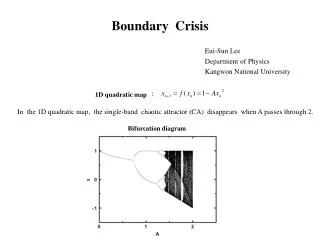
Boundary Crisis Eui-Sun Lee Department of Physics Kangwon National University 1D quadratic map : Bifurcation diagram In the 1D quadratic map, the single-band chaotic attractor (CA) disappears when A passes through 2.
Boundary crisis • Basin-boundary The initial points inside the basin are attracted to a given attractor, while the initial points outside of the basin would be expelled , and never return to the attractor. The unstable fixed point exists on the boundary of the CA’s basin boundary. • Basin : Region between and . : unstable fixed point • Boundary crisis occurs through the collision between the CA and the boundary of its basin .
The Chaotic Transient When the parameter increases through 2, the boundary crisis occurs, and then the CA transforms into the chaotic transient . After the boundary crisis , a trajectory starting from the initial point in the interval (1-A,1) exhibits the chaotic behavior before it diverges away.→ Chaotic Transient
Lifetime of The Chaotic Transient • As the parameter increases, the lifetime of the chaotic transient becomes shorter. • Average lifetime of the trajectories, starting from 1,000 randomly chosen initial point • with uniform probability in the interval(1-A,1) for a given parameter, may be regarded as • iteration time which when a trajectories (|x|) becomes larger than 10.0 .