Download

1 / 40
400 likes | 486 Views
Explore how nuclear charge, shielding, and atomic radius influence periodic trends. Learn about ions, ionic radius, ionization energy, and electronegativity in the periodic table. Discover the behavior of elements across periods and down groups.

E N D
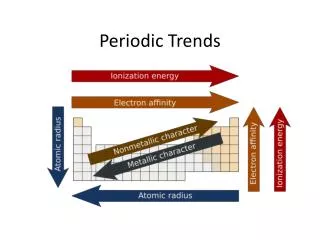
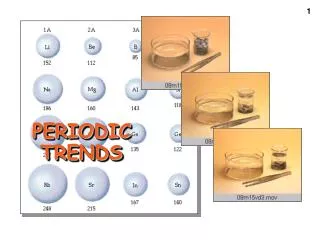
Periodic Trends • Nuclear Charge • Shielding • Atomic Radius
Nuclear Charge • Charge of the atom
Periodic Trends • Nuclear Charge • Shielding • Atomic Radius
SHIELDING • Lower energy levels “shield” higher energy levels from full nuclear charge
Periodic Trends • Nuclear Charge • Shielding • Atomic Radius
Atomic Radius Size of the atom video
IONS • An atom or group of atoms that have a positive and negative charge • Form when electrons are transferred b/w atoms
Cations • Positively charged ion • Form by losing electron(s) • Smaller than original atom • Metals
Anions • Negatively charge ion • Form by gaining electron(s) • Larger than original atom • Non-metals
PERIODIC TRENDS • Ionic Radius • Ionization Energy • Electronegativity
IONIC RADIUS • Size of the Ion
Decreases ()Across Period Cations smaller than anions-trend restarts with NM
PERIODIC TRENDS • Ionic Radius • Ionization Energy • Electronegativity
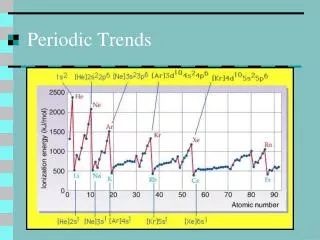
Ionization Energy Energy requires to remove an electron video
Ionization Energy • 1st ionization energy = 1 + charge ion • 2nd ionization energy = 2 + charge ion • 3rd ionization energy = 3 + charge ion.
PERIODIC TRENDS • Ionization Energy • Ionic Radius • Electronegativity
Electronegativity Ability of an atom to attract electron(s) video
Reactivity • Metals • Periods – across • Groups – down • Nonmetals • Periods- across • Groups- down
Which group is more ionic? More electronegative? • Alkali Metals and Alkaline-Earth Metals