Download
1 / 20
210 likes | 333 Views
This study explores the microbial life in ancient salt deposits, focusing on viable halophilic microorganisms. Findings reveal that haloarchaea can survive in extreme conditions over geological timescales, making them crucial for understanding astrobiology, the carbon cycle, and their potential role in the safe storage of transuranian waste. The research examines various salt formations across Europe and their significance, highlighting the adaptability of microorganisms like Halococcus and Halobacterium in extreme saline environments and their implications for extraterrestrial life and waste management strategies.

E N D
Viablehalophilicmicroorganisms in deepancientsaltdepositsHelga Stan-Lotter1, Sergiu Fendrihan21University of Salzburg, Austria; 2RomanianBioresourceCentre, Bucharest, Romania
Microbiallife in subterraneanhalite Alpine deposits, Carpathian rock salt, Others Survival over geological times? Significancefor astrobiology carboncycle, storageoftransuranianwasteand CO2
Locations of several Alpine Permo-Triassic salt deposits and salt mines, some of them abandoned, in Austria and Southern Germany. Salt deposits are depicted in red.
Permiansaltlayers (saltmine in Berchtesgaden, Germany), ca. 250 millionyearsold
Haloarchaeal colonies on salt agar diameter of colonies: ca. 1 cm
HalococcussalifodinaeDSM 8989T(found in Alpine and Zechstein deposits) Haloarchaeal isolates from Permo-Triassic salt Halococcus dombrowskii DSM 14522T
HalobacteriumsalinarumNRC-1(left); HalobacteriumnoricenseDSM 15978T, an isolate from Alpine Permian salt(right), which was found also in the WIPP site, Carlsbad, USA; bars, 1000 nm
Natronobacterium, Natrinema, Haloterrigena Uncultured haloarchaea Halobacterium Halococcus Uncultured haloarchaea Haloferax Halorubrum
Location of the Praid salt mine Active salt mines in Romania
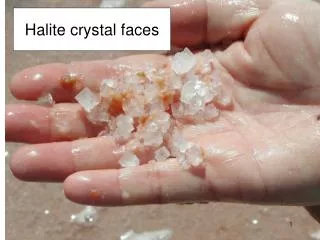
Extraterrestrial halite SNC-Meteorites (from Mars; Shergotty, NakhlaChassigny) Murchisonmeteorite (from asteroid belt) Monahans meteorite (from asteroid belt) salt pools on the surface of Mars ocean on the Jovian moon Europa Enceladus (moon of Saturn) geysirs Red and blue sodium chloride crystals in the Monahans meteorite. Each picture is 1 mm in width. .
Howmighthaloarchaeasurvive in ancientsaltsediments ? Haloarchaeaembedded in halitecrystals Pre-stained cells of Hbt. salinarum in halite fluid inclusions. Low magnification (left) and high magnification of an individual fluid inclusion (right)
Halobacteriumsalinarum NRC-1 normal growth: rods (A);after embedding in fluid inclusions: spheres (B – G) Reduction of water activity (aw) leads to formation of spheres, provided multiple genomes are present (Zerulla & Soppa, 2014)
Significance Astrobiology:Viablehaloarchaeasurvivedgeologicaltimesperiods in ancientsaltsediments, possibly in a stablerestingstate (spheres) Carboninteractions: Halococcusspeciesandmaybeotherhaloarchaeaarepresent in theoceans; a RuBisCo-like geneispresent in haloarchaea, but CO2fixationhas not beenclarified. Cluesfromancientcommunities? Other aspects: usageofsaltdeposits/minesasstoragefortransuranianwaste, also CO2 was proposed - thus, itismandatorytostudypropertiesofindigenoushalophiliccommunities