Download
1 / 28
290 likes | 429 Views
The prevalence of wireless networks introduces new security concerns, including increased potential for remote attacks without physical access. This analysis examines the limitations of the Wired Equivalent Privacy (WEP) protocol used in 802.11 security, which fails to meet essential security goals like preventing eavesdropping and message modification. We detail various attacks on WEP, including keystream reuse and CRC vulnerabilities, emphasizing the urgent need for more robust technological solutions to safeguard wireless communications from eavesdropping and unauthorized access.

E N D
Wireless Privacy:Analysis of 802.11 Security Nikita Borisov UC Berkeley nikitab@cs.berkeley.edu
Wireless Security • Wireless networks becoming prevalent • New security concerns • More attack opportunities • No need for physical access • Attack from a distance • 1km or more with good antennae • No physical evidence of attack • Typical LAN protection insufficient • Need stronger technological measures
802.11 Security • “Wired Equivalent Privacy” protocol (WEP) • Protects wireless data transmissions • Security goals: • Prevent eavesdropping [privacy] • Prevent message modification [integrity] • Control network access [access control] • Essentially, equivalent to wired security • Only protects the wireless link • … not an end-to-end solution
Summary of Attacks • None of security goals are met • “Insecurity of 802.11” [BGW’01] • Keystream reuse [privacy] • CRC attacks [integrity] • Authentication spoofing [access control] • IP redirection & TCP reaction attacks [privacy] • “Inductive chosen plaintext attack” [Arb’01] • CRC attack [privacy] • “Weaknesses in RC4 key scheduling” [FMS’01] • RC4 weakness [privacy]
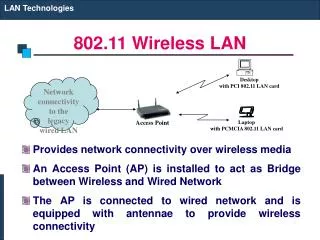
Protocol Setup LAN Access Point Shared Key Mobile Station Mobile Station Mobile Station
Protocol Setup • Mobile station shares key with access point • Various key distribution strategies • One shared key per installation is common • Integrity check (CRC) computed over packet • Packet + CRC are encrypted with shared key • … together with an IV • Receiver decrypts and verifies CRC • Packet accepted if verification succeeds
Packet Format RC4 encrypted … IV Payload CRC-32 Key ID byte
Encryption Algorithm • Use RC4 – a well-studied algorithm • RC4 is a stream cipher • Expands a key into an infinite pseudorandom keystream • To encrypt, XOR keystream with plaintext • Random ^ Anything = Random • Encryption same as decryption (keystream cancels out)
XOR XOR Example “WIRELESS” = 574952454C455353 RC4(“foo”) = 0123456789ABCDEF 566A1722C5EE9EBC RC4(“foo”) = 0123456789ABCDEF “WIRELESS” = 574952454C455353
Initialization Vectors • Encrypting two messages with the same part of RC4 keystream is disastrous: • C1 = P1 RC4(key) • C2 = P2 RC4(key) • C1 C2 = P1 P2 • Keystream cancels out! • Use initialization vector to augment the key • Key = base_key || IV • Different IVs produce different keystreams • Include IV (unencrypted) in header
Problem 1: IV collision • What if two messages use the same IV? • Same IV same keystream! • C1 C2 = P1 P2 • If P1 is known, P2 is immediately available • Otherwise, use expected distribution of P1 and P2 to discover contents • Much of network traffic contents predictable • Easier when three or more packets collide
Finding IV collisions • 802.11 doesn’t specify how to pick IVs • Doesn’t even require a new one per packet • Many implementations reset IV to 0 at startup and then count up • Further, only 224 IV choices • Collisions guaranteed after enough time • Several hours to several days • Collisions more likely if: • Keys are long-lived • Same key is used for multiple machines
Decryption Dictionary • Once a packet is successfully decrypted, we can recover the keystream: • RC4(k,IV) = P xor C • Use it to decrypt packets with same IV • If we have 224 known plaintexts, can decrypt every packet • Store decryption dictionary on a cheap hard drive • For counting IVs starting at 0, smaller dictionaries can be effective
Problem 2: Linear Checksum • Encrypted CRC-32 used to check integrity • Fine for random errors, but not deliberate ones • CRC is linear • I.e. CRC(X Y) = CRC(X) CRC(Y) • RC4(k,X Y) = RC4(k,X) Y • RC4(k,CRC(XY)) = RC4(k,CRC(X)) CRC(Y) • Hence we can change bits in the packet
Payload CRC-32 011010010100…………………………………… 10110………… RC4 101101110101………………………………………………………… XOR 110111100001…………………………………… 11011………… XOR 100111100001…………………………………… 11101………… Modified Packet Packet Modification 00110………… 010000000000…………………………………… RC4(k,CRC(XY)) = RC4(k,CRC(X)) CRC(Y)
Can modify packets! • “Integrity check” does not prevent packet modification • Can maliciously flip bits in packets • Modify active streams • Bypass access control • Partial knowledge of packet is sufficient • Only modify the known portion
Typical Operation Internet Packet Packet Access Point Recipient Packet Mobile Station
Redirection Attack Internet Packet’ Access Point Recipient Packet’ Packet’ Evil 2 Evil 1 Mobile Station
Redirection Attack • Suppose we can guess destination IP in encrypted packet • Flip bits to change IP to Evil 2, send it to AP • Tricks to adjust IP checksum (in paper) • AP decrypts it, then forwards it to Evil 2 • Incorrect TCP checksum not checked until Evil 2 sees the packet!
Reaction Attacks • Send encrypted packet to the AP • AP decrypts it for further processing • System reacts to the decrypted data • Monitor reaction • Learn information about decrypted data • Usually only a few bits • Reaction becomes a side channel • Learn more data with multiple experiments
TCP reaction attack • Carefully modify an intercepted packet • TCP checksum will be correct or incorrect depending on the decrypted contents • Reinject packet, watch reaction • ACK received TCP checksum correct • Otherwise, checksum failed • Learn one bit of information about packet • Repeat many times to discover entire packet
Fluhrer et al Attack on RC4 • Designer’s worst fear: new flaw in encryption algorithm • Attack: • Monitor encrypted traffic • Look for special IV values that reveal information about key state • Recover key after several million packets (many technical details omitted)
Practical Considerations • Park van outside of house or office • With good antenna and line of sight, can be many blocks away • Use off-the-shelf wireless card • Monitor and inject traffic • Injection potentially difficult, but possible • Software to do Fluhrer et al attack readily available
Defences • Various commercial 802.11 enhancements • Almost always, “enhanced security” means better key management • Does not protect against active attacks (reaction, redirection) or the Fluhrer et al attack • Wait for next version of WEP • Still in progress • Use a VPN over the wireless network • Assumes wireless LAN untrusted • Works around any security flaws
Lesson: Public Review Essential • IEEE used “open design” • Anyone allowed to participate meetings • Standard documents freely available (used to cost $$) • However: • Only employees sponsored by companies can afford the time and expense of meetings • No review by cryptography community • Many flaws are not new • E.g. CRC attacks, reaction attacks • Arguably, even the Fluhrer et al attack could have been prevented
Lesson: Message Integrity Essential • Message integrity was only a secondary goal • However, poor integrity can compromise privacy as well: • IP redirection attack • TCP reaction attack • Inductive CRC attack [Arbaugh’01] • Proper cryptographic authentication necessary • “Encryption without integrity checking is all but useless” [Bellovin’96]
Privacy Protection in Infrastructure • Insecure network tools prevalent • File sharing (FTP, NFS, SMB) • E-mail (SMTP, POP) • Etc. • Wireless networks expose security problems • Attacks possible in wired networks, but accessible to many more people in wireless ones • Fix wireless networks or fix infrastructure? • Privacy is best protected end-to-end
Conclusions • Security is difficult to achieve • Even when good cryptography is used • WEP is insufficient to protect privacy • All security goals can be compromised • Use other technologies to secure transmissions • More information at: http://www.isaac.cs.berkeley.edu/isaac/wep-faq.html